
When waiting for the payment of a harvest to repay a campaign advance, the responsiveness of the bank advisor is just as important as the interest rate. Choosing a bank for a farming operation is not just about comparing pricing grids: it’s about finding a partner who can understand a cash flow calendar aligned with the seasons, not with traditional monthly deadlines.
Agricultural Cash Flow and Seasonal Rhythm: The True Test of a Bank
In a grain farming operation, cash inflows are concentrated after the harvest. In a dairy farm, they are more regular, but expenses (feed, veterinary) vary greatly depending on the period. In both cases, the bank must absorb cash flow delays of several months without triggering an incident.
This is where one distinguishes a general banking offer from a true agricultural service. A campaign credit line, for example, allows for financing inputs in the spring and repaying upon sale. Not all banks offer this type of facility, or they do so with rigid conditions that do not fit the field.
Before comparing rates, it is wise to check if the institution offers financing tools for the operating cycle: advance on harvest, flexible campaign credit, seasonal cash facility. The challenge in choosing the right bank for farmers often hinges on this operational flexibility rather than the promise of a low rate displayed in the window.
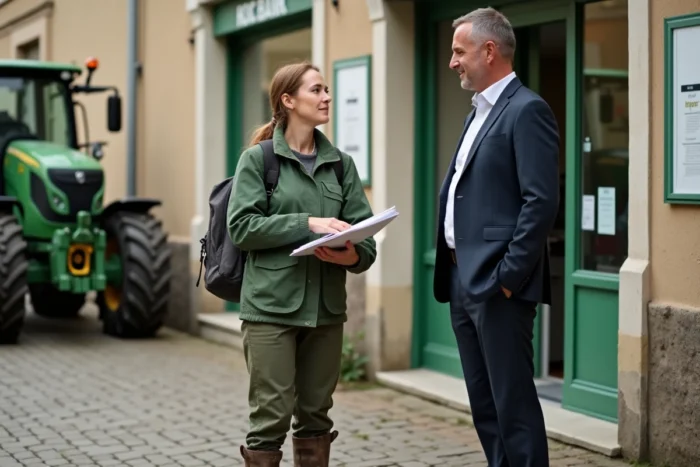
A Specialized Agricultural Advisor: An Underestimated Criterion
An advisor who knows the difference between an EARL and a SCEA, who understands what a climatic hazard implies for a vegetable grower’s cash flow, or who can read a projected installation plan, changes the quality of the banking relationship.
Several institutions position dedicated advisors for the agricultural world. Crédit Agricole, historically rooted in the sector, has networks of advisors trained in local industries. Crédit Mutuel presents itself as the second bank of French agriculture with a dense territorial network. Banque Populaire highlights experts gathered around agricultural and viticultural issues.
What We Expect from an Agricultural Advisor
- The ability to anticipate financing needs related to key moments (installation, campaign, equipment investment, climatic setbacks) without waiting for the overdraft to explode
- A knowledge of public schemes (subsidized loans, specific guarantees for installation) to guide the operator towards the right setups
- Regular follow-up adapted to the cultural calendar, not an annual meeting aligned with the accounting year
Feedback varies on this point: in some regional branches, the advisor changes every two years, which disrupts the continuity of follow-up. Before signing, one can ask what the average turnover of advisors in the agricultural sector of the targeted agency is.
Agricultural Installation Financing: Comparing Beyond the Rate
The installation represents the moment when the operator needs solid banking support the most. Purchase of land, takeover of a business, acquisition of buildings, first livestock, equipment: the amounts involved often exceed what a project holder can guarantee alone.
Most specialized banks offer installation loans with deferred repayment. The real difference lies in the duration of the deferral, the possibility of adapting the deadlines to the first years (when incomes are low), and the articulation with public aids such as the Young Farmer Grant.
Agricultural Equipment: Classic Credit or Alternative Solutions
For a tractor or a combine harvester, one can choose between a classic bank loan, a lease (leasing), or financing through a CUMA. Each option has its accounting and tax implications.
Leasing allows for not burdening the balance sheet while using recent equipment. Some banks offer rental options with a purchase option integrated into their agricultural range. Others have nothing specific and redirect to third-party organizations, complicating follow-up.

Alternatives to Bank Credit: Crowdlending and Agricultural Participatory Financing
Agricultural financing is no longer solely through traditional banks. Crowdfunding platforms like MiiMOSA allow operators to raise funds directly from individuals or investors sensitive to agricultural projects.
This type of solution is particularly suited for diversification projects (on-farm processing, agritourism, short circuits) where the classic bank file struggles to convince a credit committee accustomed to conventional schemes.
We also observe the emergence of financing solutions backed by real assets (land, stocks) offered by non-banking actors, especially for agricultural SMEs facing excessively long processing times in banks. These alternatives do not replace the main bank, but they usefully complement the financial toolbox of an operation.
Comparison Grid for Choosing Your Agricultural Bank
| Criterion | Questions to Ask |
|---|---|
| Campaign Credit | Modifiable amount? Repayment aligned with the harvest? |
| Dedicated Advisor | Agricultural training? Position rotation? |
| Installation | Repayment deferral? Articulation with public aids? |
| Equipment | Integrated leasing or referral to a third party? |
| Climatic Hazards | Possible deadline postponement? Coupled multi-risk insurance? |
| Digital Tools | Dedicated professional application? Real-time cash flow monitoring? |
The best choice depends on the life stage of the operation. A young farmer in large crops does not have the same priorities as a winemaker who exports part of his production. Rather than searching for “the best agricultural bank” in absolute terms, it is more efficient to list the three main constraints (seasonal cash flow, equipment financing, support for installation) and test each institution’s response on these specific points.