
The laundry aisle of a supermarket now offers much more than just two options. Between bottles, cardboard boxes, pods, and sheets, the choice has become more complex in recent years. The question of powder versus liquid detergent remains the most frequently asked, as it relates to the daily lives of every household and the answer varies depending on the type of laundry, the machine, and washing habits.
Chemical Composition: What Really Distinguishes Powder and Liquid
Competitors often address the difference between the two formats based on their uses. Before getting there, it is essential to understand what happens at the molecular level, as it is the formulation that dictates performance.
Powder detergent contains oxygen-based bleaching agents (sodium percarbonate) and zeolites that act as anti-scale agents. These components remain stable in dry form but degrade in aqueous environments, which explains why they are not found, or very little, in liquid detergents.
Liquid detergent relies on surfactants in solution and enzymes stabilized in water. It dissolves quickly, even at low temperatures, and does not leave any granular residue on the fibers. However, the absence of bleaching agents limits its action on oxidizable stains (tea, wine, grass).
For those who want to delve deeper into the subject before making a choice, choosing between powder and liquid detergent allows for a comparison of the two formats based on several concrete criteria.
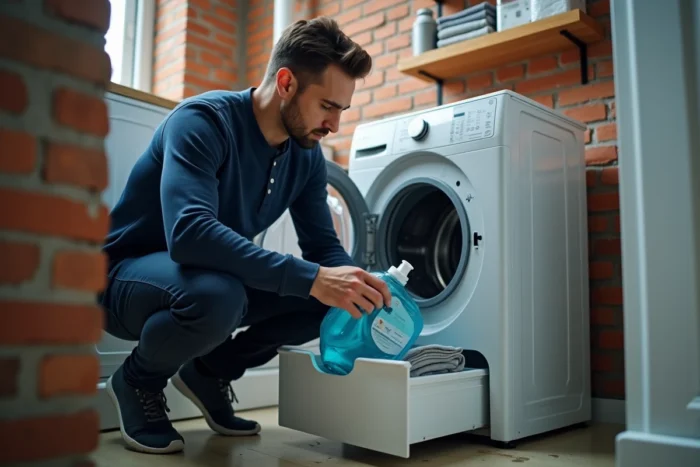
Powder Detergent and Washing Temperature: A Technical Duo
Powder gives its best results starting at 40 °C. Below this temperature, the granules do not always dissolve completely, especially in front-loading machines with little water. White residues may then appear on dark clothing or remain trapped in the door seal.
Powder excels on white laundry washed at 60 °C or higher. Sodium percarbonate releases active oxygen at these temperatures, which removes stains and revitalizes cotton fibers. For sheets, towels, and dishcloths, powder remains the most technically suitable format.
Liquid detergent, on the other hand, works from 20 °C. This is a significant advantage when we know that most domestic cycles now run at 30 or 40 °C for energy-saving reasons. In a cold cycle, liquid dissolves completely where powder leaves traces.
Impact on the Washing Machine: Clogging and Maintenance
Clogging of the machine comes up in all discussions on this topic, but feedback from the field varies on this point. Some service technicians attribute bad odors to liquid detergents, while others blame the overdosing of powder. The reality combines both.
- Liquid detergent leaves a greasy film in the drum, pipes, and detergent drawer. This biofilm, nourished by surfactant residues, promotes the growth of mold if the machine never runs at high temperatures.
- Powder detergent, when overdosed or used at low temperatures, leaves limescale deposits in the water circuit. These deposits stiffen the seals and can clog the filters.
- Alternating between the two formats reduces both types of clogging. A monthly cycle at 60 °C with powder helps strip the biofilm left by the liquid, while the liquid prevents the accumulation of mineral residues between two hot washes.
Overdosing remains the primary factor in clogging, regardless of the format. The dose recommended by the manufacturer corresponds to a standard load with average water hardness. In soft water, reducing the dose by a third is often sufficient.
Detergent Pods and Sheets: Should We Move Beyond the Powder-Liquid Duel?
The market for laundry pods was already worth $12.89 billion in 2025 globally. This format is growing because it eliminates the dosing problem (each pod contains a precise dose) and reduces the risks of spills or dust.
Detergent sheets are also gaining ground, driven by an ecological argument: minimal packaging, reduced weight for transport, and no liquid plastic. Their cleaning power is presented as comparable to traditional detergents, even superior in some cases, while reducing pollutants released into the water.
These alternative formats do not render powder or liquid obsolete. They cater to different uses:
- Pods are suitable for households that want to simplify dosing without sacrificing effectiveness.
- Sheets appeal to environmentally conscious individuals and those with limited space (studios, RVs).
- Powder remains unbeatable for very dirty white laundry. Liquid retains the advantage for delicate fabrics and colors.
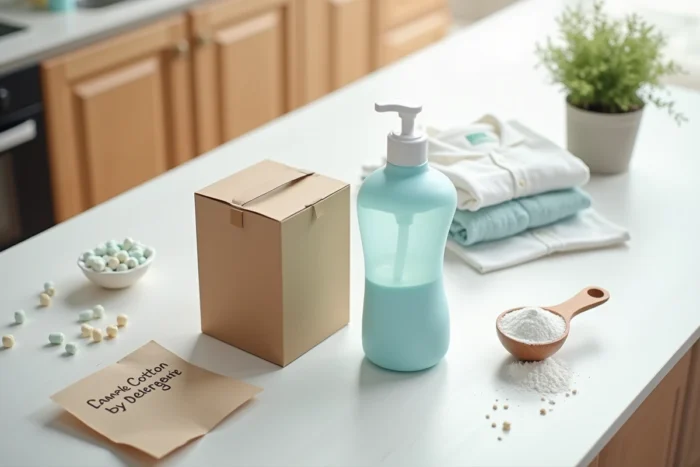
Choosing Criteria Based on Laundry Profile
Rather than making a categorical decision, it is more useful to reason by the dominant type of laundry in the household.
A household with young children accumulates bibs, onesies, and stained sheets. Powder, used at 60 °C, better removes protein stains (milk, spit-up) thanks to its oxygenated agents. For the colorful clothes of the same children, a 30 °C cycle with liquid preserves the colors.
A couple without children who mainly washes city clothes (shirts, pants, dresses) can rely on liquid for almost all their cycles, reserving powder for washing white sheets every two weeks.
The question of storage also matters. A 3-liter bottle takes up more space than a box of concentrated powder, but it is less likely to harden in case of humidity. Powder, exposed to open air, forms unusable blocks within weeks in a poorly ventilated bathroom.
The choice between powder and liquid detergent does not call for a single answer. The composition of each format makes it suitable for specific situations, and households that achieve the best results are generally those that keep both in their laundry room.