
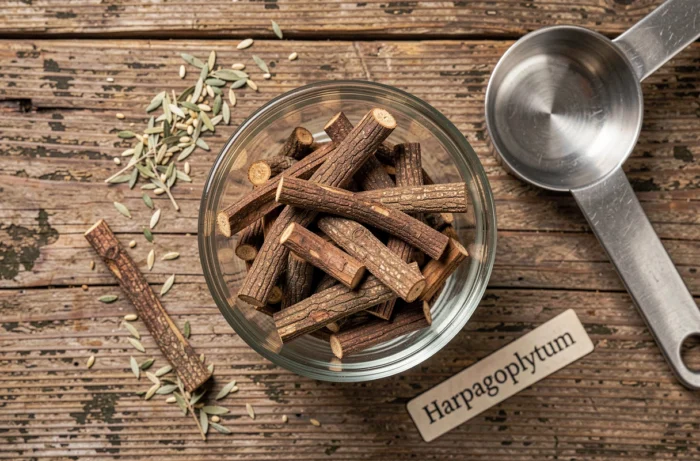
Harpagophytum, or devil’s claw, is a South African plant whose secondary roots contain iridoids, primarily harpagoside. These molecules give it documented anti-inflammatory properties in humans and in laboratory settings. In arthritic dogs, the plant is increasingly used as a supplement, but the level of clinical evidence specific to the canine species remains low. Understanding this gap between human data and veterinary reality allows for informed choices.
Harpagoside and Joint Inflammation: What Biochemistry Explains
Canine osteoarthritis is characterized by a progressive degradation of the articular cartilage, accompanied by chronic inflammation. COX-2 and lipoxygenase enzymes produce inflammatory mediators (prostaglandins, leukotrienes) that maintain pain and accelerate cartilage destruction.
Harpagoside, the main active ingredient of harpagophytum, inhibits these two enzymatic pathways in the laboratory. This mechanism is similar to that of non-steroidal anti-inflammatory drugs (NSAIDs), but with significantly lower potency. The biochemical data mainly comes from in vitro studies or research conducted in humans.
This point deserves to be made clear: the European Medicines Agency (EMA) classifies harpagophytum as a traditional use for minor joint pain. This classification does not constitute clinical validation for the treatment of canine osteoarthritis. Owners considering using harpagophytum and osteoarthritis in dogs should keep this nuance in mind to adjust their expectations.

Harpagophytum for Arthritic Dogs: Dosage Forms and Variability of Extracts
Harpagophytum for dogs comes in several forms: root powder, capsules of dry extract, liquid solutions. Each dosage form has a different concentration of harpagoside, and this is where things get complicated.
The harpagoside content varies significantly from one product to another. A standardized extract does not deliver the same amount of active ingredient as a raw root powder. This variability makes any dose extrapolation risky, especially when the dosage is derived from human recommendations.
Criteria for Evaluating a Harpagophytum Supplement
- The explicit mention of the harpagoside content on the label, expressed as a percentage or in milligrams per dose. Without this information, comparing two products is impossible.
- The part of the plant used: only the secondary roots (tubers) concentrate iridoids in significant amounts. A product based on the main root or aerial parts will have reduced activity.
- The dosage form suitable for the dog: a liquid solution mixes more easily with food than a capsule, which improves long-term compliance.
Adjusting the dose to the weight of the animal seems logical, but no clinical study in dogs has established a validated appropriate dosage. The veterinarian remains the only interlocutor capable of adjusting the dose based on the stage of osteoarthritis and the general condition of the dog.
Contraindications and Interactions with Veterinary Treatments
Harpagophytum is not harmless. The plant is contraindicated in dogs suffering from gastric ulcers, diabetes, or kidney failure. Pregnant females should not receive it either.
The most closely monitored interaction concerns the combination with veterinary NSAIDs (meloxicam, carprofen). Since harpagophytum acts on the same enzymatic pathways, a cumulative effect may increase the risk of gastrointestinal effects: vomiting, diarrhea, or even digestive ulceration.
Anticoagulant treatments represent another area of caution. Harpagoside could potentiate the effect of these medications, although specific data for dogs is again lacking. Any addition of herbal therapy to an ongoing treatment requires veterinary advice, not an autonomous decision by the owner.
Dog Osteoarthritis and a Multimodal Approach: The Real Role of Harpagophytum
The AAHA (2022) recommendations for managing canine arthritic pain emphasize an approach that combines several levers. In this context, harpagophytum does not replace any of the pillars of treatment.
The Levers with the Strongest Evidence
- Weight control: an overweight dog exerts increased mechanical pressure on its joints, which worsens cartilage degradation and pain. Dietary management is the first lever to activate.
- Appropriate physical activity: regular, moderate walks maintain joint mobility and muscle mass without triggering inflammatory flare-ups.
- Omega-3 fatty acids (EPA/DHA): the evidence for anti-inflammatory efficacy in dogs is stronger for omega-3s than for most other dietary supplements, including harpagophytum.
- Analgesics prescribed and monitored by the veterinarian: NSAIDs, monoclonal antibodies (such as bedinvetmab), or other molecules depending on the stage of the disease.
Harpagophytum can be integrated as a supplement in this approach, particularly for early stages where pain remains moderate. A supplementation trial should be evaluated based on observable changes (ease of getting up, walking distance, desire to play) and not continued out of habit for months without visible results.
Evaluating the Effect on Your Dog
After two to three weeks of supplementation, observe specific indicators: does the dog get up more easily in the morning? Does it limp less after a walk? Does it seek play more? If no improvement appears within this timeframe, the supplementation should be reevaluated with the veterinarian rather than extended indefinitely.
Harpagophytum offers a coherent anti-inflammatory mechanism biochemically, but the gap between laboratory data and canine clinical evidence remains wide. Considering it as a tool among others, within a supervised protocol, remains the most reasonable approach for an arthritic dog.