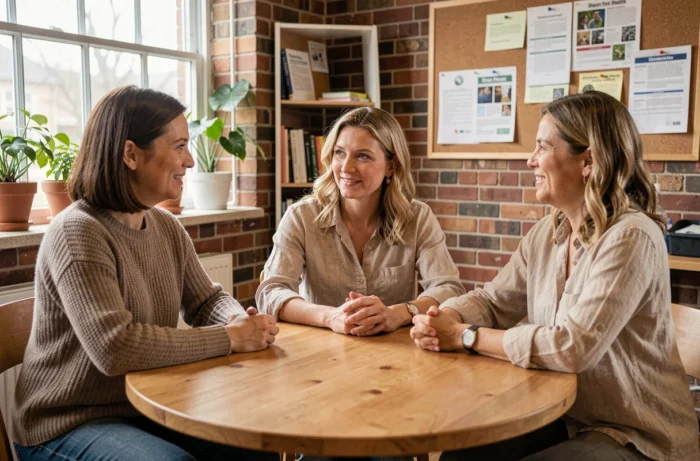
A woman leaving a violent home needs, in the hours that follow, a place to sleep, access to her rights, and a non-judgmental listening ear. These three needs arise simultaneously, and the organizations that address them collectively remain poorly known. Support spaces for women, whether called women’s centers, women’s houses, or listening associations, precisely offer this grouping of services under one roof.
Emergency financial assistance and banking autonomy: two concrete levers since 2023
When supporting a woman who is a victim of domestic violence towards leaving, the first barrier is rarely psychological. It is the bank account. A joint account controlled by the partner blocks access to housing, food, and transportation.
Since December 2023, emergency financial assistance is available without income conditions, in the form of a grant or an interest-free loan depending on the situation. This assistance, managed by the Caf, helps cover initial relocation or living expenses without waiting for the processing of a complete social file.
In 2025, the initiative “The Right to Open,” led by La Banque Postale, added a second lever: the accelerated opening of a bank account for victims who have left their home. The bank card is sent to a secure address, not to the marital home. This type of concrete measure changes the game for women who until then had to choose between staying in a violent household and losing all access to their finances.
Women’s centers and local associations play a relay role here: they are often the ones who direct individuals to these systems, help compile the file, and provide a substitute postal address. For example, you can visit Centre de Femmes Entrelles online to identify available resources in your area and understand the support processes offered.
Women’s center, women’s house, listening association: understanding the differences
The vocabulary varies from city to city, and this confusion hinders access to services. Three main types of structures are distinguished.
- Women’s houses are generally affiliated with a hospital or healthcare center. They combine medical care (gynecology, psychotrauma), social support, and legal guidance.
- Women’s centers operate on a community model. They offer support groups, administrative assistance, sometimes temporary housing, and serve as an entry point for women who do not yet identify as victims in the legal sense.
- Listening and support associations, such as those in the Solidarité Femmes network, provide a helpline (3919, free and anonymous, 24/7) and direct individuals to local structures suited to each situation.
In practice, these categories overlap. A women’s house may host an associative branch, and a community center may have an agreement with a hospital service. The challenge for the person concerned is not to classify the structure, but to find one that meets her immediate need in her department.
Coercive control and non-physical violence: what local structures identify first
General directories mainly direct individuals to responses for physical or sexual violence. Feedback varies on this point, but several field actors report that women victims of coercive control take longer to enter a structure.
Coercive control refers to daily domination strategies: control of movements, social relationships, clothing or food choices. In France, this concept does not yet constitute an autonomous offense in criminal law, although recent legislative proposals seek to integrate it.
Women’s centers and local associations identify these situations before the judicial system because they welcome women who come for a completely different reason: a reintegration workshop, a French class, a parenting support group. It is in these non-medicalized and non-judicial spaces that women feel most liberated to speak early on.
Services that go beyond emergency response
A support space for women is not limited to crisis management. Most offer support over several months, which can include:
- Individual or group psychological follow-up, adapted to psychotrauma
- Assistance in finding independent housing and compiling administrative files (Caf, prefecture, court)
- Empowerment workshops: budget management, access to employment, sexual and reproductive health
- Referral to lawyers specialized in the rights of victims of domestic violence
Long-term support is what reduces the risk of returning to a violent home. Structures that offer several months of follow-up, with a single point of contact, achieve better results than one-off interventions.
Finding a support space for women in your city or department
The first reflex remains 3919, accessible free of charge and without identification. The listeners direct individuals to the nearest structure based on geographical location and type of need (housing, listening, care, rights).
For independent searches, the directory on the government website arretonslesviolences.gouv.fr allows filtering by department and type of service.
Women in precarious situations are the least well covered by these directories, according to the Federation of Solidarity Actors. Homeless women, migrant women without residency permits, women in isolated rural areas: for these profiles, passing through a local association often remains the only pathway to access rights.
Emergency financial assistance, the opening of a secure bank account, specialized listening, and legal support exist. The problem is not their absence, but their visibility. Every department has structures capable of responding, provided one knows they exist and is willing to walk through the door.