The taxation of swimming pools is based on three criteria that accumulate: the surface area of the pool, whether it is removable or fixed, and its annual installation duration. Since 2026, the flat rate value of the development tax for swimming pools has risen to €251/m², a decrease compared to previous years. This reduction does not offset the revaluation of property tax bases or the freedom of municipalities to increase their local rates.
Understanding where the boundary lies between taxable and non-taxable pools requires going beyond just the surface area criterion.
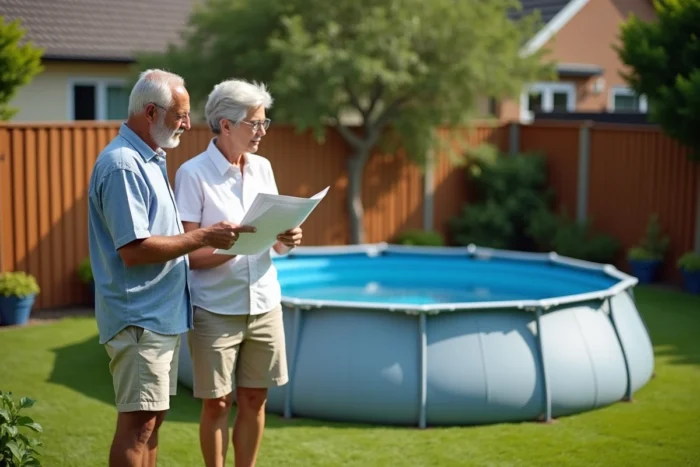
Above-ground pool over 10 m²: the trap of installation duration
Most articles on the subject focus on the 10 m² threshold. This threshold exists, but it only tells part of the story. An above-ground pool with a surface area exceeding 10 m² can remain non-taxable, provided it is not installed for more than three months per year.
In practical terms, a tubular pool of 12 or 15 m² set up in early June and taken down by the end of August escapes the development tax and property tax. Beyond three months in place, the tax authorities can reclassify it as a permanent structure, even if it remains technically removable. Field reports show that some owners who left their tubular pool up all year received a letter from the tax administration requesting regularization.
This surface-duration combination is the decisive criterion for large above-ground pools. Choosing the right non-taxable pool size thus involves balancing swimming comfort and calendar constraints.
Pool surface area below 10 m²: what taxation really takes into account
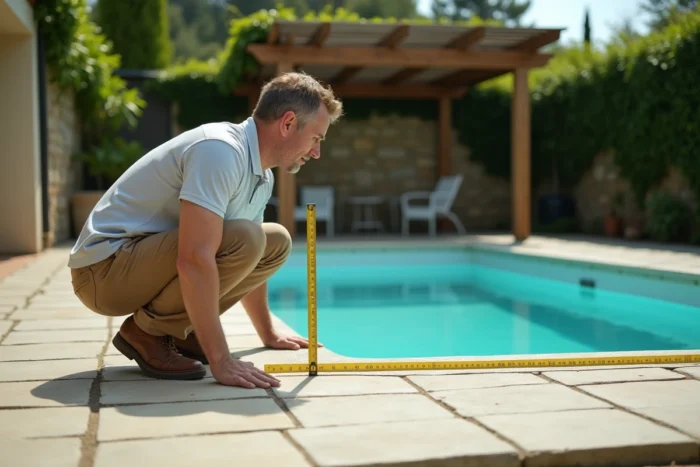
Below 10 m² of pool surface area, a removable pool does not require prior work declaration or tax declaration, regardless of its installation duration. This threshold applies to the interior surface area of the pool (the water surface), not to the total ground footprint including coping or decking.
Mini-pools (sometimes called plunge pools) precisely exploit this limit. With common dimensions of 2 x 4 m or 2.5 x 3.5 m, they remain below the threshold while offering a functional swimming space. Their growing popularity is due as much to the search for tax savings as to adaptation to small urban gardens.
Be cautious about a often-overlooked point: a mini-pool that is inground or semi-inground and less than 10 m² remains taxable if it is constructed and permanently anchored to the ground. The removable nature is as crucial as the surface area.
Development tax and property tax on pools: two distinct logics
Property owners often confuse these two levies. They do not operate in the same way and do not apply at the same times.
Development tax for inground pools
The development tax is a one-time levy, paid at the time of construction. It applies to any inground or semi-inground pool requiring a prior declaration or building permit. Its calculation is based on the surface area of the pool multiplied by the flat rate value (€251/m² in 2026), then by the municipal and departmental rates.
For a pool of 20 m², the calculation base would thus be €5,020 before applying local rates. Depending on the municipality, the final amount varies significantly.
Property tax and declared pool
The property tax, on the other hand, is annual. An inground pool increases the cadastral rental value of the property, which is reflected each year on the tax notice. The bases are automatically revalued (approximately +0.8% in 2026), and municipalities can vote for independent rate increases.
The structural trend remains an increase in property tax on inground pools, despite the temporary decrease in the flat rate value of the development tax. An owner installing a standard-sized inground pool must factor this recurring cost into their long-term budget.
Detection by artificial intelligence: what the tax authorities spot from the sky
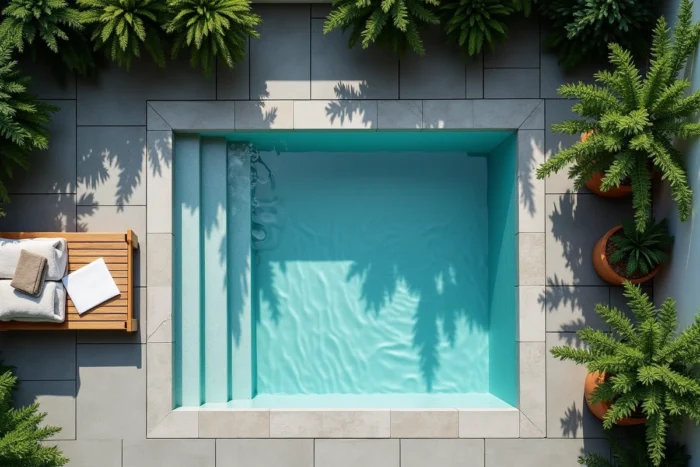
For several years, the DGFiP has been using artificial intelligence tools to cross-reference aerial images and cadastral data. The goal: to identify unreported pools. This system has already allowed the detection of thousands of unregistered pools across the country.
The system identifies inground and semi-inground pools visible in aerial views. Above-ground pools taken down in winter are more easily overlooked by this surveillance, which reinforces the fiscal interest of the seasonal model. In contrast, an above-ground pool left in place all year becomes detectable and potentially reclassifiable.
Sanctions for non-declaration include a tax catch-up that can go back several years, along with penalties. Spontaneous regularization remains the best option for owners in an irregular situation.
Cumulative criteria for a non-taxable pool
Three conditions must be met simultaneously for a pool to escape any taxation:
- A pool surface area of less than 10 m², measured at the level of the interior water surface, not the overall ground footprint
- A fully removable nature, without foundations, masonry, or permanent anchoring to the ground
- A duration of installation not exceeding three consecutive months per year for pools over 10 m², or no duration limit for those under 10 m² that are removable
If any of these criteria are missing, the pool falls under the tax regime for permanent constructions, with mandatory declaration and associated taxation.
Choosing a non-taxable pool is therefore not just a question of square meters. The nature of the structure and the usage calendar weigh as much as the surface area. An above-ground pool of 8 m² placed on a specially poured concrete slab could be contested by the administration. Conversely, a 15 m² tubular pool set up on grass for three months each summer remains off the tax radar, as long as the dismantling is effective and documentable.