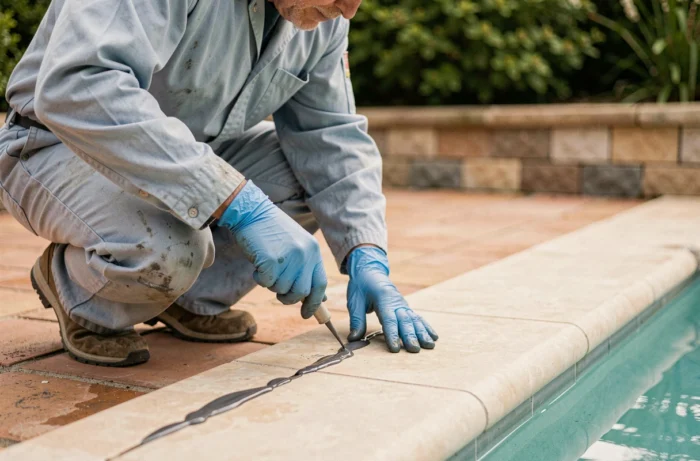
Regrouting a tiled pool without breaking everything seems like a tempting shortcut. However, applying epoxy grout directly over an existing joint in an immersed environment raises technical questions that most tutorials gloss over. The nature of the existing substrate, its actual condition below the waterline, and the behavior of epoxy resin in the presence of residual moisture condition the result far more than the application gesture itself.
Compatibility between old cement grout and new epoxy in pools
The first instinct before any intervention is to determine the nature of the existing joint. A crumbly cement joint requires removal before reinstallation, as epoxy cannot compensate for a substrate that is crumbling. The resin adheres through a chemical bond to a cohesive surface: if the old joint crumbles under the tip of a screwdriver, no surface preparation will correct this structural defect.
On the other hand, a cement joint that is still hard and well-adhered to the tiles can serve as a base, provided it is sufficiently excavated to offer a true depth for adhesion. Field reports vary on the minimum thickness to be removed, but several recent guides converge on at least half the thickness of the joint, or around five millimeters deep.
The situation differs when the old joint is itself epoxy. Regrouting epoxy over epoxy works better in theory (chemical compatibility), but the smooth surface of the old joint reduces mechanical adhesion. Sanding or scraping the surface then becomes necessary to create roughness. This point is rarely explained in consumer content, which often treats regrouting as a single gesture, regardless of the substrate.
Before deciding to apply an epoxy pool joint over an existing one, it is essential to accurately assess the condition of the pool. A methodical survey of the joints, meter by meter, allows for mapping healthy areas and areas that need complete removal.
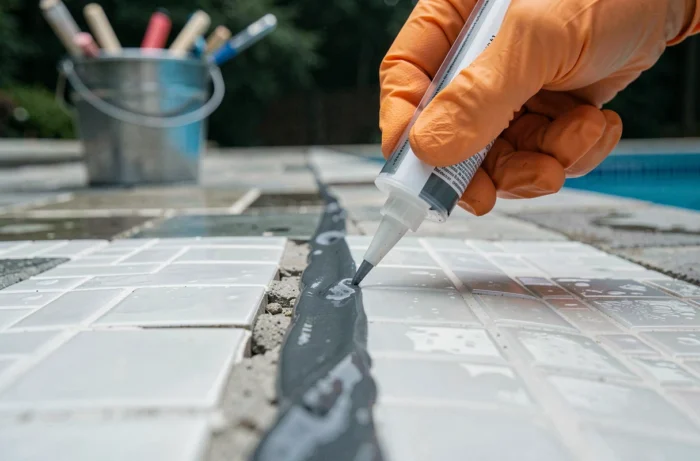
Residual moisture test before applying epoxy in the pool
Moisture is the silent enemy of epoxy joint regrouting in pools. A pool drained for a few days may appear dry on the surface while still retaining residual moisture trapped in the substrate. This trapped water compromises the polymerization of the resin and can cause delamination within a few months.
A simple test involves attaching a piece of clear plastic film to the bottom or wall of the pool, taped on all four sides, and leaving it in place for twenty-four hours. If condensation appears under the film, the substrate is not ready. This inexpensive field check prevents starting a project destined for failure.
The drying time required after draining depends on several factors:
- The porosity of the substrate (raw concrete, waterproof screed, mosaic on a frame) directly influences the evaporation rate of residual water.
- The ventilation of the pool plays a crucial role: a covered pool without air circulation can remain damp much longer than an outdoor pool in dry weather.
- The ambient temperature also conditions the polymerization of the epoxy: below a certain threshold, the resin hardens poorly, even on a dry substrate.
The available data does not allow for setting a universal drying time. Each pool has a different profile, and only the test under plastic film provides a reliable answer for a given project.
Epoxy cleaning window: a constraint that changes the project
Applying an epoxy joint in a pool differs radically from traditional cement grouting in one specific aspect: the working time. Once the resin-hardener mixture is prepared, the window for applying, smoothing, and especially cleaning the residues off the tiles is measured in minutes.
This parameter transforms the organization of the project. Working in small areas (one to two square meters maximum per batch) becomes the only realistic method. Preparing too much product at once risks having the epoxy start to polymerize on the tile before it can be wiped off. The hardened residual film is then extremely difficult to remove without damaging the glaze of the mosaic or tiles.
Cleaning tools must be ready even before opening the container. An appropriate sponge (like an epoxy joint sponge, denser than a regular sponge), frequently renewed clean water, and low-angle lighting to spot traces constitute the minimum. Underestimating this cleaning phase is the primary cause of visual failure in epoxy joint regrouting in pools, even when adhesion is good.
Working alone or with a partner on the pool
On a standard-sized pool, working in pairs changes the game. One person applies and fills the joint, while the other immediately follows with the sponge. This slight delay of a few minutes between application and cleaning remains within the resin’s working window.
Working alone is possible but requires further reducing the area per batch and accepting a slower pace. On a full pool, this can extend the project by several days.
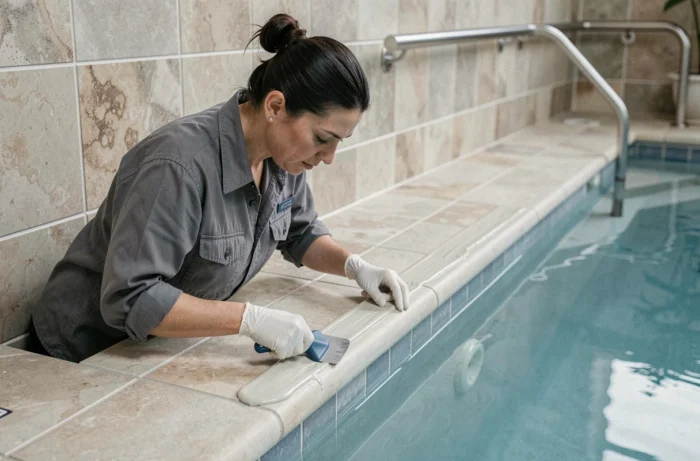
Resistance to salt and treatment products: limits to know
Epoxy is often presented as waterproof and resistant to everything. In a pool environment, this claim deserves to be nuanced. The chemical resistance depends on the exact formulation of the product used, and not all commercial epoxy joints are formulated for permanent immersion in treated water.
A saltwater pool, for example, generates chlorine through electrolysis. This continuous production exposes the joints to a chemical stress different from that of traditional stabilized chlorine treatment. Some manufacturers explicitly specify compatibility with salt electrolysis, while others do not. Checking the product’s technical data sheet on this specific point avoids unpleasant surprises after a few seasons.
Resistance to UV is another underestimated parameter. Joints in the upper part of the pool, exposed to sunlight when the water level drops, can yellow or degrade faster than joints that are permanently submerged. This differential aging creates visible shade disparities over the long term.
The choice of product is as important as the preparation of the substrate. An epoxy joint designed for bathrooms does not offer the same guarantees as a product formulated for permanent immersion in treated pools. Reading the technical data sheet beyond the simple word “pool” on the packaging remains the only reliable precaution before committing to a regrouting project.