During a first attempt at prostate massage, the most common reflex is to go too fast, using an unsuitable lubricant and without preparing the body. The result: discomfort, frustration, and sometimes the definitive abandonment of a practice that, when done correctly, opens up a very different range of sensations compared to classic penile stimulation. This guide lays the concrete foundations for successfully performing a prostate massage, detailing what works in practice and what recent medical sources recommend avoiding.
Prostate Massage and PSA Levels: An Overlooked Interaction
This point is rarely discussed in practical guides, and it is an angle that competing content almost systematically ignores. Prostate stimulation (massage, ejaculation, intense cycling) can transiently increase blood PSA levels. A test conducted too soon after a prostate massage risks skewing the results and leading to unnecessary follow-up examinations.
Recent clinical recommendations are clear: avoid any prostate massage and ejaculation in the 48 hours preceding a PSA test. During a urological consultation, blood sampling should be done before any rectal examination. If you regularly practice prostate massage and have a health check-up scheduled, plan your sessions accordingly.
This detail may seem secondary, but for men undergoing screening, a false positive causes stress and additional investigations. It’s better to know this in advance.
Body Preparation and Lubricant Choice for Prostate Massage
Before consulting a tutorial for effective prostate massage, we start with the fundamentals that condition the entire experience.
The choice of lubricant makes a significant difference. The anal mucosa does not produce natural lubrication. A water-based gel is suitable for use with silicone accessories, but it dries faster and requires frequent reapplications. A silicone-based lubricant lasts longer, but it is incompatible with silicone sex toys (it degrades the surface of the material).
Physical preparation is just as important as the product used:
- A trip to the bathroom and a simple shower are sufficient in most cases. Enemas are not necessary for digital stimulation, and their repeated use can irritate the mucosa.
- Muscle relaxation of the sphincter is achieved with slow, deep breathing. Nothing should be inserted until the body is relaxed.
- Nails should be cut short and filed. A thin latex or nitrile glove adds a layer of safety and facilitates sliding.
Prostate Stimulation Technique: Concrete Actions and Common Mistakes
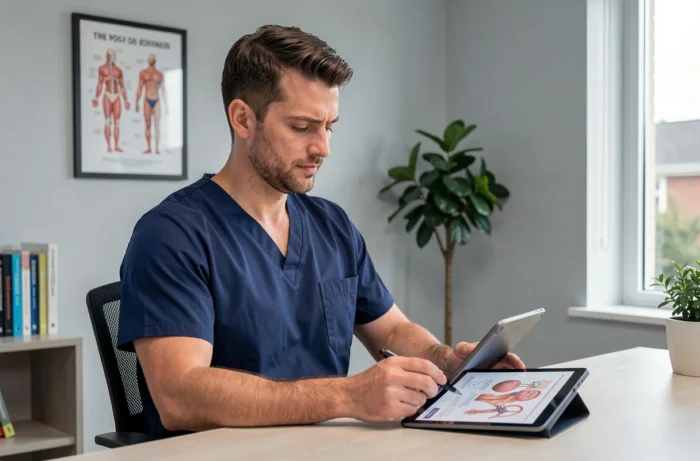
The prostate is located a few centimeters from the anal entrance, on the anterior wall (belly side). Upon touch, one can feel a slightly raised area, firmer in texture than the surrounding tissues. The sensation of “good direction” is confirmed by a distinct signal, often described as a pleasant pressure or a slight urge to urinate.
The Movement That Works
A “come here” gesture with the index finger, slow and steady, is the basis of digital stimulation. You press gently, release, and repeat. The pressure remains moderate: you massage, you don’t press like a button. The intensity builds over several minutes.
Feedback varies on this point, but many men report that prostate pleasure takes longer to establish than classic penile stimulation. Counting at least ten to fifteen minutes before evaluating sensations is a useful guideline.
Errors That Cut Prostate Pleasure
Going too deep, too fast, or too hard: these three reflexes ruin the majority of first experiences. The prostate responds better to gradual stimulation than to firm pressure. An ergonomically shaped prostate vibrator (curved, with a safety stop) can facilitate the angle, but starting with the finger allows for better pressure calibration and understanding of the area.
Another common mistake: neglecting overall arousal. Prostate massage rarely works “cold.” Combining prostate stimulation with penile stimulation or caresses on other erogenous zones significantly enhances the body’s receptivity.
Medical Contraindications for Prostate Massage: When Not to Practice
This aspect is non-negotiable. In the case of acute bacterial prostatitis (fever, intense pelvic pain, burning during urination), prostate massage is strictly contraindicated. The main risk is the dissemination of the infection into the bloodstream, which can lead to sepsis. Urologists are trained never to massage a prostate suspected of acute prostatitis.
For men diagnosed with benign prostatic hyperplasia or cancer, any prostate stimulation should be discussed with the treating physician. Self-massage is not a substitute for medical treatment, and the therapeutic benefits often mentioned online (drainage, reduction of chronic inflammation) remain debated in recent scientific literature.
- Acute prostatitis with fever: absolute contraindication.
- Anal lesions (fissures, active hemorrhoids): postpone practice until healing.
- Sharp pain during stimulation: stop immediately. A prostate massage should never be painful.
Medical-Grade Silicone Accessories and Prostate Vibrators: Selection Criteria
For those who want to go beyond the finger, a dedicated prostate stimulator offers a more consistent angle of stimulation. The main criterion is the material: medical-grade silicone is the reference, non-porous, hypoallergenic, and compatible with sterilization.
Shape matters more than size. A curved model with a rounded tip targets the prostate better than a straight accessory. The presence of a flared base or external stop is a mandatory safety feature for any anal use. Multi-intensity vibrators allow you to find the optimal stimulation threshold without manual force.
Prostate massage remains a practice that refines over time. The first sessions primarily serve to map sensations, without a performance objective. Prostate pleasure builds through listening to the body, consistency, and a rigorous hygiene framework.