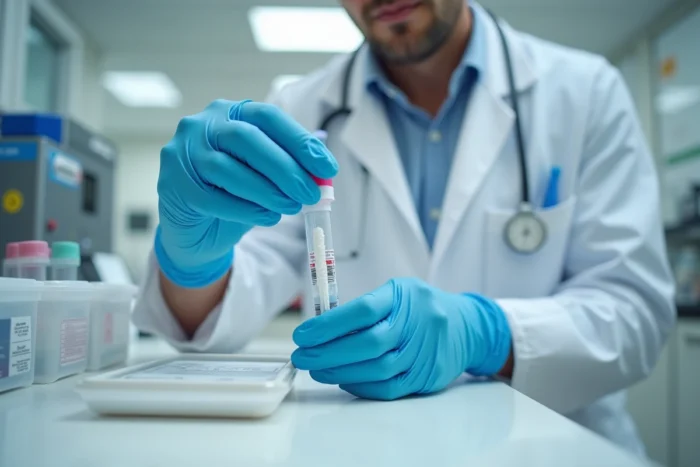
A saliva test detects cocaine by searching for its metabolites in the oral fluid. The commonly accepted detection window is between 24 and 48 hours after the last use, with documented cases extending up to 72 hours depending on the consumer’s profile and the sensitivity of the device used.
This range varies significantly from one context to another. The rapid test used during a roadside check and the analysis conducted in a toxicology laboratory do not share the same thresholds or detection capabilities. Understanding this difference helps assess what a positive or negative result truly means.
Cocaine Metabolism: What the Saliva Test Really Looks For
Cocaine itself disappears quickly from the blood and saliva, often within a few hours. The tests do not only target the parent molecule: they primarily look for benzoylecgonine, a metabolite produced by the liver during the breakdown of cocaine.
This metabolite persists much longer than the active substance. In saliva, its presence remains measurable for an average of one to two days. In regular or chronic users, the accumulation of metabolites in the body can extend this window up to three days.
The method of consumption also plays a direct role. Smoked (crack) or injected cocaine reaches higher and faster plasma peaks than snorted cocaine. The body then produces more metabolites in a shorter time, which can alter the duration for which a saliva test for cocaine remains positive after use.
Roadside Saliva Test and Laboratory Analysis: Different Detection Thresholds
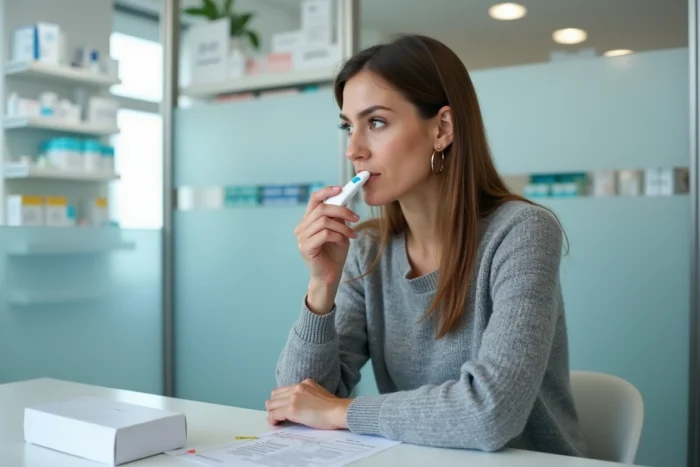
The technical sheets of devices used in workplaces or during roadside checks indicate a practical detection window of 6 to 24 hours. Clinical toxicology tables, on the other hand, state 24 to 72 hours. This discrepancy, rarely explained in public guides, is due to a specific technical reason.
The positivity thresholds are intentionally raised on rapid tests to limit false positives related to trace amounts. A rapid immunochromatographic test applies a higher concentration threshold than an analysis using chromatography coupled with mass spectrometry conducted in a laboratory.
In practice, this means that a driver may test negative on a roadside saliva test while a laboratory analysis on the same sample would still detect metabolites. The result depends as much on the device as on the biological reality.
Direct Consequence on Roadside Checks
In the event of a positive check, law enforcement proceeds with a confirmatory blood sample. It is this blood analysis, conducted in a laboratory, that holds legal weight. The initial saliva test serves as a rapid screening tool, not as definitive proof.
Cocaine and Alcohol: A Specific Metabolite That Prolongs Detection
The simultaneous consumption of cocaine and alcohol produces a metabolite absent when cocaine is taken alone: cocaethylene. This molecule is synthesized by the liver when both substances are present in the body at the same time.
Cocaethylene has a longer half-life than benzoylecgonine. Its presence extends the overall detection window and increases the likelihood of a positive test beyond the usual 48 hours. Clinical toxicology sources indicate that this scenario is common, as co-consumption of cocaine and alcohol is prevalent.
This point also has a health dimension: cocaethylene is more cardiotoxic than cocaine alone, which increases the risk while driving. Saliva tests do not specifically distinguish this metabolite, but its presence contributes to maintaining a positive signal for a longer time.
Individual Factors That Modify Saliva Detection Duration
Beyond the type of test and method of consumption, several physiological variables influence the persistence of metabolites in saliva.
- Liver function: the liver is responsible for transforming cocaine into metabolites. Impaired liver function slows this process and prolongs the presence of the parent substance in the body.
- Hydration level: dehydration concentrates metabolites in saliva, which can make a test positive at a stage where a well-hydrated subject would be negative.
- Frequency of use: in an occasional user, the saliva detection window generally remains under 48 hours. In a regular user, the accumulation of metabolites can extend detection up to 72 hours.
- Body weight and fat mass: since cocaine is partially lipophilic, a higher fat mass may alter the elimination kinetics.
Comparison with Other Screening Matrices
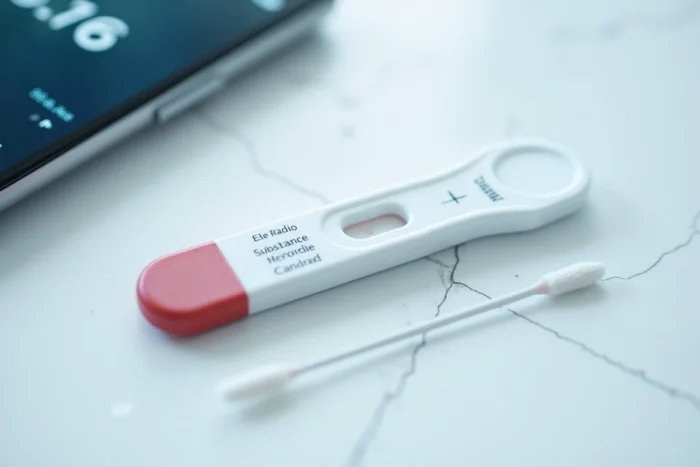
Saliva offers a shorter detection window compared to other types of samples. Urine can detect benzoylecgonine for several days in an occasional user, and sometimes longer in a chronic user. Blood presents an intermediate window.
Hair constitutes the matrix with the longest window: cocaine metabolites incorporate into keratin as it grows and can be found for several months. However, this type of analysis is reserved for specific judicial or medical contexts, never used roadside.
| Matrix | Typical Detection Window |
|---|---|
| Saliva | 24 to 48 h (up to 72 h) |
| Urine | Several days |
| Blood | Intermediate window |
| Hair | Several months |
The choice of matrix depends on the objective: saliva detects recent use, urine covers a broader period, and hair reconstructs a history.
Thus, the answer to the question of saliva detection of cocaine is not a single figure. It lies within a range of 24 to 72 hours, modulated by the testing device, possible co-consumption of alcohol, and the metabolic profile of the subject. A negative roadside rapid test does not guarantee the complete absence of metabolites in the body.