Stone houses charm with their character, but they pose a recurring problem as temperatures drop: thick walls, often perceived as protective, let heat escape when they are poorly maintained or inadequately insulated. Keeping a stone house warm requires different actions than for a conventional building. The thermal inertia of stone, its sensitivity to moisture, and the limited compatibility with certain insulations profoundly change the approach to be taken.
Damp stone walls: the problem that insulation alone does not solve
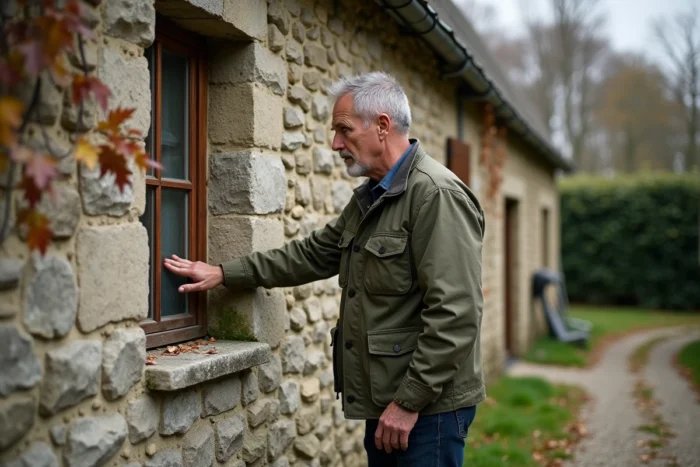
Before discussing insulation or heating, the first question to ask concerns the condition of the wall itself. A damp stone wall must be dried out before any insulation, otherwise the issues will worsen instead of disappearing.
Installing insulation on a moisture-laden wall causes condensation at the stone-insulation interface. The result: mold, degradation of the stone, and thermal comfort that deteriorates over time. Several sources specializing in old buildings confirm that this scenario frequently recurs in poorly prepared renovations.
The main cause is often cement pointing done during previous work. Cement prevents the wall from “breathing,” traps moisture inside the masonry, and encourages rising damp. The solution involves lime repointing, which restores the wall’s permeability to water vapor.
This preliminary work conditions the success of everything else. Applying these tips for warmth in stone houses assumes starting with healthy and breathable walls.
Thermal insulation compatible with stone: materials and precautions
Not all insulation solutions are suitable for stone walls. Synthetic insulators (polystyrene, polyurethane) block the migration of water vapor and reproduce the same problem as cement: moisture remains trapped in the wall.
Preferred bio-based insulators
Materials that are permeable to water vapor are the only ones truly suitable for old stone buildings. Their ability to allow moisture to pass while slowing thermal losses makes them reliable allies for this type of wall.
- Wood fiber, in rigid or semi-rigid panels, offers good thermal resistance and high permeability to water vapor. It can be installed as both interior and exterior insulation.
- Hemp wool or the hemp-lime mix (sprayed coating) adapts to the irregularities of stone walls and naturally regulates ambient humidity.
- Cellulose wadding, blown into a ventilated counter-wall, is a high-performing option provided that an air gap is maintained between the wall and the insulation.
Interior insulation with a ventilated air gap remains the most common technique for stone houses whose façade must be preserved. The air gap allows the wall to continue to expel its moisture without compromising the performance of the insulation.
External insulation: when it’s possible
External thermal insulation (ITE) eliminates most thermal bridges, particularly at wall corners and floor-wall junctions. However, it alters the appearance of the façade, making it incompatible with buildings located in protected or classified areas. Field reports vary on this point: some municipalities allow an exterior lime-hemp coating that preserves a mineral appearance close to the original, while others refuse it.
Thermal bridges and joinery: the leaks that are often underestimated
Insulating walls without addressing thermal bridges is like closing a door while leaving the windows open. In a stone house, the most critical areas of heat loss are at the wall-floor junctions, window frames, and the roof level.
Windows represent a major source of heat loss in old buildings. Replacing single glazing with double glazing with enhanced insulation significantly reduces thermal losses at this level. The choice of frame also matters: a wood or mixed wood-aluminum frame offers better thermal bridge break than a standard aluminum frame.
Shutters play a complementary role that is often overlooked. Closed at night, they create a buffer layer of air between the outside and the glazing, limiting thermal exchanges. The gain is modest compared to changing the glazing, but it adds to the overall effectiveness.
Heating suitable for stone houses: leveraging thermal inertia
The thermal inertia of stone, which makes the house slow to heat, becomes an asset once the walls are at the right temperature. Stone stores heat and gradually releases it, smoothing out indoor temperature variations and reducing the need for heating restarts.
To take advantage of this inertia, a soft and continuous heating system works better than a rapid temperature rise system. Low-temperature underfloor heating or inertia radiators (cast iron, ceramic) align well with this operation. They maintain the walls at a stable temperature, avoiding the cooling-reheating cycles that generate discomfort and overconsumption.
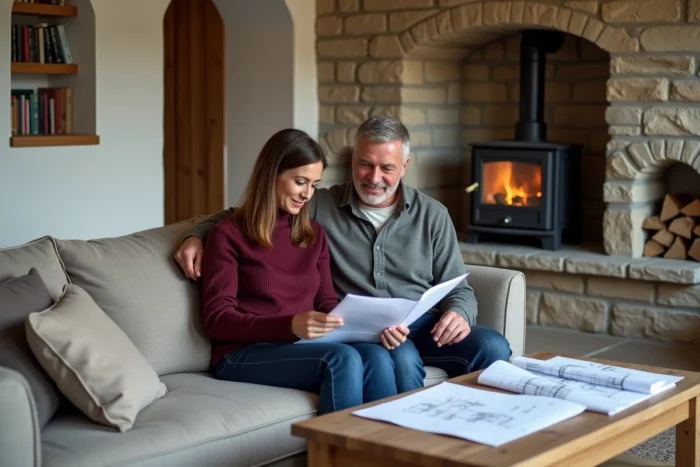
A wood stove or a pellet insert can complement the main system in the living area, provided that the flue is compatible with the building’s configuration. The radiant heat from the fire directly warms the adjacent stone walls, which then release it for several hours after the fire is out.
- Favor continuous low-temperature heating rather than occasional high-power restarts
- Ensure that the ventilation system (single or double flow VMC) is sized to avoid over-ventilation that would cool the walls
- Adapt the regulation room by room, as the inertia varies according to the thickness and exposure of the walls
Ventilation deserves special attention. A poorly adjusted VMC in a stone house can negate some of the insulation gains by renewing the indoor air faster than necessary. A balance between sufficient air renewal and heat retention needs to be found, ideally with the help of a professional specialized in old buildings.
Keeping a stone house warm relies on a comprehensive logic: dried walls, compatible insulation, treated thermal bridges, heating adapted to inertia. Each link depends on the previous one. Skipping the drying step or choosing an unsuitable insulation compromises the entire chain, regardless of the budget invested in heating.