The question of who writes the letters to the bride consistently arises whenever a wedding is being planned. The short answer: anyone whose words truly matter to her. However, the quality of these letters depends less on familial ties than on the writing method, and this is where most guides remain superficial.
Letter to the Bride: A Specific Anecdote is Worth More than a Declaration of Love
We observe a clear shift in the expectations of brides. Generic phrases like “I wish you all the happiness in the world” or “may your love last forever” no longer have the desired effect. A specific memory resonates more than an abstract declaration.
The mechanism is simple: a concrete anecdote proves that the message was crafted for this person, not copied and pasted from a template. A shared detail (a fit of laughter during a trip, a late-night conversation, a symbolic object) anchors the emotion in the couple’s or relationship’s real experience.
The classic trap is trying to be exhaustive. Telling the entire story of the relationship dilutes the message. To go further on who writes the letters to the bride, we recommend choosing a single strong memory and developing it in three or four sentences. The rest of the letter revolves around this pivotal moment.

Who Writes the Letter to the Bride Depending on the Wedding Format
Small weddings, which are on the rise, change the game. When the circle is limited to close family and long-time friends, each letter carries a stronger emotional weight. The bride does not receive thirty conventional messages but five or six dense texts.
In this context, the usual writers are parents, siblings, and the best friend. The groom himself is increasingly writing a separate letter from his vows, delivered on the morning of the ceremony.
Parents and Siblings: The Most Anticipated Letter
The bride’s mother remains the most frequent writer. Her letter is also the one that generates the most pressure, as expectations are high on both sides. A technical tip: do not try to summarize twenty-five years of shared life in one page. It is better to isolate a pivotal moment (the day she left home, a challenge faced together) and write from there.
The father, sister, or brother often bring a different tone, more factual or humorous. This complementarity of tones enriches a collection of letters.
Best Friend and Witnesses: The Complicit Tone
The witnesses have an advantage: they know the bride in a way that parents do not see. Anecdotes from evenings, trips, or candid conversations provide a useful counterpoint to family letters. The tone can be lighter without losing sincerity.
Method for Writing a Touching Wedding Message
Writing a letter to the bride is less about inspiration and more about structure. Here are the steps we recommend to achieve a text that works both in reading and aloud:
- Choose a specific memory and express it in two descriptive sentences, with a sensory detail (a place, a smell, a sound) that places the bride back in the scene.
- Link this memory to a concrete quality of the bride, not a vague adjective (“generous”) but an observed action (“you crossed the city at three in the morning to come”).
- End with a short projection into the couple’s future, without excessive lyricism. One sentence is enough.
This three-part structure (memory, embodied quality, projection) produces a coherent text in about ten lines. The handwritten letter remains the most appreciated format, as it involves a visible effort and an object that the bride will keep.

Medium and Timing for Delivering the Letter to the Bride
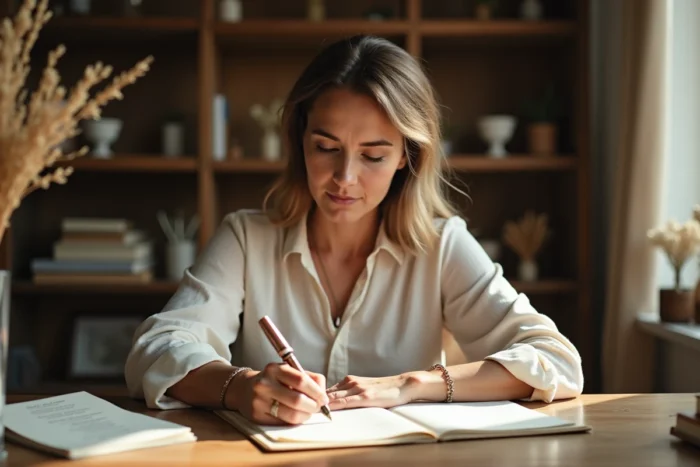
The choice of medium is not trivial. Quality stationery, a simple card, or a dedicated notebook changes the perception of the message. Avoid standard printer paper: the texture is part of the emotional experience.
The timing of the delivery is as important as the content. Two options dominate:
- The night before, during a calm moment among close ones. This timing allows the bride to reread the letter without the pressure of the big day.
- On the morning of the wedding, slipped into a box with a small symbolic object. The element of surprise amplifies the emotion, but the bride will have less time to absorb the message.
- During preparations, read aloud by the author in front of a closed circle. This intimate format is gaining ground in small weddings.
Reading the letter in a closed circle the night before the wedding aligns with the current trend towards authenticity and minimalism. The bride receives the message in a setting conducive to emotion, away from the hustle and bustle of the ceremony.
Common Mistakes in Letters of Vows to the Bride
The first mistake is starting with “Dear [first name]” followed by a context paragraph (“On this very special day…”). This type of opening immediately signals a conventional message. Starting directly with the memory or an addressed sentence creates an immersion effect.
The second trap: multiplying quotes or poems found online. A letter to the bride draws its strength from the author’s own voice. Inserting a famous quote dilutes this uniqueness.
The third point: length. A letter that is too long loses its impact. Eight to fifteen handwritten lines are enough to convey sincere emotion. Beyond that, the risk of repetition or filler increases significantly.
The most touching message remains the one that expresses a true sentiment, with simple words, on a medium that the bride can reread in ten years, finding exactly the emotion of the day she received it.