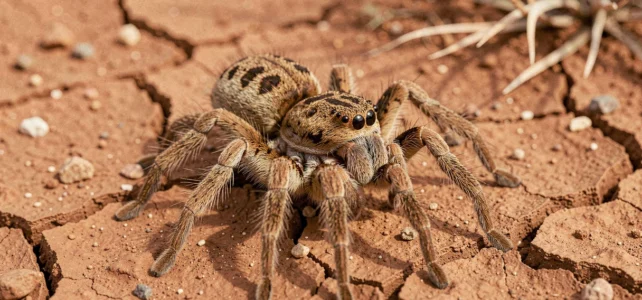
In the arid regions of the Horn of Africa, an arachnid with an evocative name draws attention well beyond scientific circles. The Djibouti knife spider, actually a solifuge, owes its reputation to often exaggerated tales circulating from military bases established in the area. Neither truly a spider nor a scorpion, this creature occupies a unique place in the world of arachnids.
Djibouti Solifuge: An Arachnid of Military Bases, Not a Desert Monster
French-language articles generally describe the knife spider as an abstract “desert” creature. The reality is more precise. The most documented accounts of this animal in Djibouti come from military personnel, particularly Americans stationed at Camp Lemonnier.
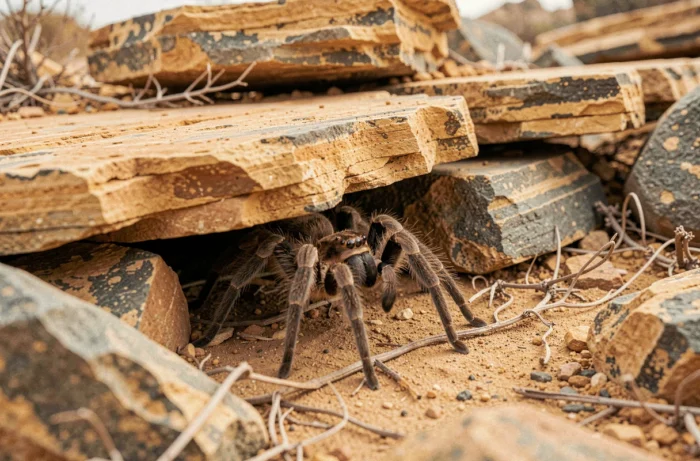
Solifuges are regularly observed in hangars, technical areas, and around illuminated facilities at night. This is no coincidence: solifuges flee the sun and seek shade, including that cast by vehicles or people. This behavior has fueled the legend of an animal that “chases” humans.
In reality, the solifuge does not seek to attack. It simply follows the nearest shaded area to escape the heat. Military bases, with their metal structures, nighttime lighting, and nooks, create a micro-ecosystem particularly favorable to their presence. It is in this very specific context that the Djibouti knife spider has gained its notoriety, far from the vast desert expanses one might imagine.
Knife Spider: Why It Is Not a True Spider
The term “knife spider” is misleading. Solifuges belong to the order Solifugae, distinct from that of spiders (Araneae). Specifically, several fundamental differences separate them.
Solifuges do not produce silk and do not spin webs. Their hunting strategy relies entirely on speed and the power of their jaws. They also lack venom glands, unlike the vast majority of spiders.
Their anatomy is characteristic:
- Two massive chelicerae shaped like pincers, capable of slicing through a scorpion’s exoskeleton, which earns them the nickname “knife”
- Pedipalps ending in adhesive organs, used to capture and manipulate prey
- A body divided into two parts (prosoma and opisthosoma), but with more visible segmentation than in typical spiders
Have you ever noticed that photos of solifuges seem to show an animal with ten legs? This is a common illusion. The highly developed pedipalps resemble an extra pair of legs, but the solifuge indeed has four pairs of legs like any arachnid.
Speed and Nocturnal Hunting of the Solifuge in Djibouti
The solifuge is one of the fastest arachnids on land. This impressive speed allows it to capture a variety of prey: insects, small lizards, and other arachnids. Its technique is direct, without ambush or traps.
Hunting occurs almost exclusively at night. The solifuge detects its prey using sensory hairs distributed on its pedipalps and front legs. It does not rely on its sight for hunting but on vibrations and tactile stimuli.
Once the prey is located, the solifuge pounces on it and uses its chelicerae to cut it. These jaws function like scissors: they do not bite in the traditional sense; they slice and crush. The meal is then partially liquefied before ingestion, a common process among arachnids.
A Venomless Predator
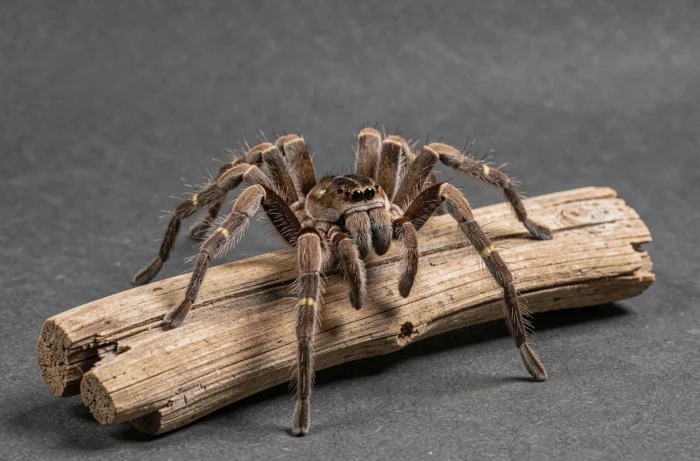
Contrary to what many online publications suggest, the solifuge has no venom. Its bite can be painful due to the mechanical power of its chelicerae, but it does not cause envenomation. The main risk for a bitten human is a secondary infection, as with any untreated wound in a warm environment.
This absence of venom has been confirmed by research in arachnology. Yet, popular beliefs persist, particularly in areas where solifuges coexist with human populations.
Misconceptions About the Djibouti Knife Spider: What Is False
Myths surrounding the solifuge are persistent. Several deserve to be examined one by one.
- The solifuge does not chase humans. It seeks shade, which creates an illusion of pursuit when a person moves in the sun
- It does not jump on people. Some solifuges can make small jumps to capture prey, but this behavior is not directed towards humans
- It does not anesthetize the skin before biting. This widely spread legend among military personnel stationed in Djibouti has no scientific basis since the animal does not produce any offensive chemical substance
- Its size is often exaggerated in photos, taken from a close low angle, which gives the impression of an animal much larger than it actually is
These beliefs have been greatly amplified by social media and military forums in the early 2000s, when the first photos of “camel spiders” circulated online from Iraq and Djibouti.
Ecological Role of the Solifuge in Arid Environments
Despite its reputation, the solifuge serves a notable ecological function. As a generalist nocturnal predator, it regulates populations of insects and small arthropods in ecosystems where food chains are short.
Removing solifuges from an environment would disrupt the local balance of invertebrates. In garrison areas in Djibouti, their presence helps limit populations of cockroaches, termites, and other pest insects, a benefit rarely mentioned.
The solifuge itself is prey for nocturnal birds, some reptiles, and large scorpions. It thus fully integrates into the food web of the arid environments of the Horn of Africa.
The Djibouti knife spider remains largely unknown to the Francophone public. Neither monstrous, venomous, nor aggressive towards humans, it is primarily an effective predator adapted to extreme conditions. The spectacular tales surrounding it often say more about our fears than about the actual biology of the animal.