
A leaking tap on a Sunday evening, a shelf to put up before a new piece of furniture arrives, a loose skirting board in the hallway: every DIY project starts with the same question—what tools do you have in the cupboard? Having the right tools at home means you won’t have to improvise with a kitchen knife or put off a simple repair indefinitely. Choosing what to keep on hand is less about buying an exhaustive range and more about prioritising the jobs you actually tackle day to day.
Safety before the first drill goes in
We tend to think first of the drill, hammer and screwdriver. Personal protective equipment often comes second, even though it underpins everything else.
Before buying any tools, put together a basic safety kit. Safety glasses, suitable gloves and earplugs cover most common risks: flying debris when drilling, cuts from a saw blade and prolonged noise from an angle grinder.
Safety shoes are often overlooked for DIY at home. Even on a modest renovation project, a heavy object can fall. A pair with reinforced toe caps costs less than a trip to A&E. Add an FFP2 dust mask whenever you’re sanding, cutting wood or handling chemicals.
Comparing Bobo Le Brico’s equipment with what you’d typically find in a beginner’s toolbox, you’ll notice that safety accessories are rarely included in starter kits sold by big-box retailers.

Hand tools for everyday jobs: what you’ll actually use each month
The temptation to buy a 40-piece kit is hard for beginners to resist. In practice, five or six hand tools cover almost all small household jobs. Add the rest as real needs arise, not because something is on sale.
The essentials that always stay in the toolbox
- A carpenter’s hammer (around 300 g) for driving nails, adjusting a joint or pulling out a nail with the built-in claw.
- A set of flathead and Phillips screwdrivers, preferably with magnetic tips to stop screws getting lost in tight spaces.
- Water-pump pliers, useful for everything from holding a plumbing nut to bending wire.
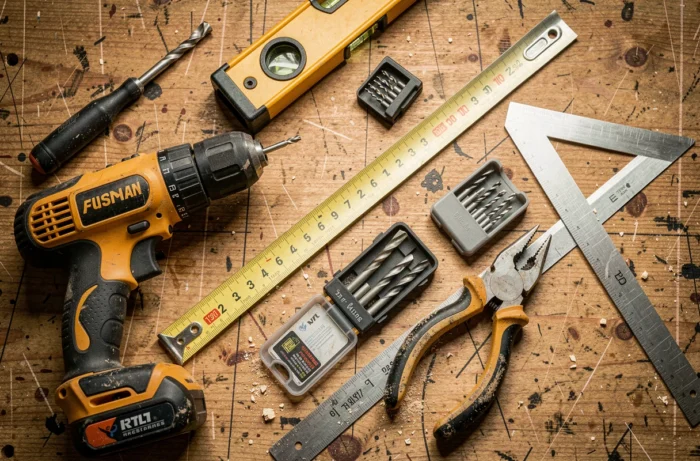
- A five-metre tape measure and a 30-centimetre spirit level, because measuring and checking that something is level are the two most common steps before fitting anything.
- A retractable-blade utility knife for opening boxes, cutting flexible flooring or stripping a cable in a pinch.
One detail that’s often overlooked: the quality of the steel in screwdriver bits matters just as much as the handle. A bit that’s too soft wears down quickly, damages the screw head and turns a quick dismantling job into a headache.
When to add an adjustable wrench or a set of Allen keys
An adjustable wrench comes in handy as soon as you tackle plumbing or assemble furniture with bolts. Allen keys come with most flat-pack furniture, but the ones supplied are often short and awkward to use. An L-shaped set ranging from 2 to 10 mm makes tightening much more comfortable.
Cordless drills and power tools: choose for the project, not the spec sheet
A cordless drill-driver is the most versatile power tool for the home. It drives screws and drills into wood and thin metal; with a hammer setting, it can also handle hollow brick. An 18 V lithium-ion model is enough for the vast majority of household projects.
The factor people often overlook isn’t maximum power, but battery compatibility. Many manufacturers offer a range of tools that share the same battery platform, including jigsaws, sanders and work lights. Investing in a compatible system means you can buy additional tools without having to buy a new battery each time.
A battery regulation to keep an eye on
From February 2027, the EU Batteries Regulation will introduce removal and replacement requirements for certain portable batteries. Checking that a tool’s battery can be replaced by the user is becoming an important buying criterion. The regulation includes exceptions for some product categories, but the overall trend is pushing manufacturers towards more accessible designs.
For cutting jobs, a jigsaw is a useful complement to a drill. It can cut boards to size, trim a worktop or cut an opening in melamine. It’s a reasonably priced tool that’s easy to store. A circular saw or router, on the other hand, is better suited to more advanced work: add one when you start taking on regular woodworking projects, not before.
Rent or borrow instead of buying: an underrated approach
A rotary hammer for fixing anchors into concrete, a belt sander for stripping a parquet floor, a heat gun for removing old paint: these tools may only be used once a year. Buying them takes up workshop space and can be a significant expense.
Tool libraries and rental services give you access to specialist equipment without the need to store or maintain it. Some also offer guidance on how to use the tools, reducing the risk of mishandling equipment you’re unfamiliar with.
A sensible rule of thumb: if you expect to use a tool fewer than three times a year, renting or borrowing is usually a better option than buying. For consumables, though—wall plugs, assorted screws, electrical tape and wood glue—always keep a small supply at home. There’s nothing more frustrating than having to stop halfway through a job because you’re missing a box of screws.
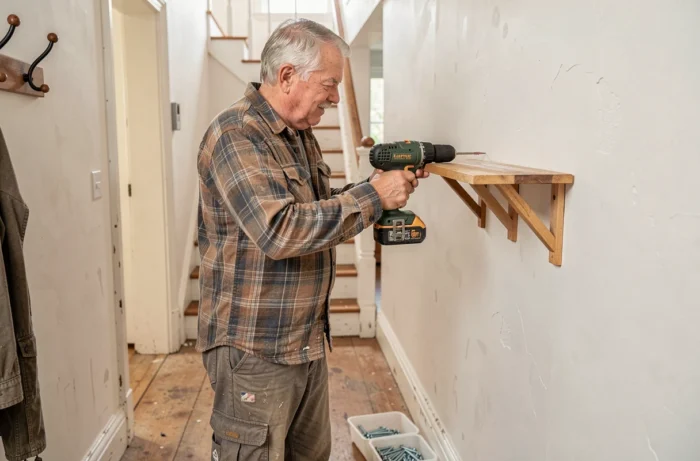
Building up your toolbox doesn’t happen in a single shopping trip. Start with safety gear and basic hand tools, add a cordless drill-driver when your projects call for one, and rent the rest. The most effective DIY kit is the one you actually use, not the one gathering dust in a drawer.