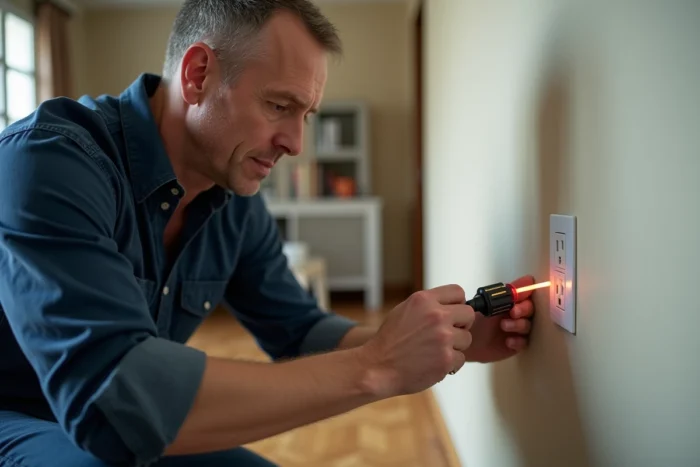
You plug in a device, and upon touching the metal casing, a slight shock runs through your fingers. This tingling sensation is not trivial: it often indicates a grounding issue. Testing the ground without a multimeter is a common concern, especially in older homes where the electrical installation hasn’t been updated in years. A few accessible checks can help identify a problem before calling an electrician.
Why the ground protects your electrical installation
The ground plays a simple role. When a device has an insulation fault (a damaged wire touching the metal casing, for example), the leakage current needs to go somewhere. Without a ground, it passes through you when you touch the device.
The grounding directs this current to the ground, via a green-yellow conductor connected to a stake or a buried ground loop. This path triggers the differential circuit breaker in the panel, cutting off the power within milliseconds. Without a functional ground, the differential cannot perform its role.
Have you noticed the metal pin that protrudes inside a French wall socket? That’s the ground contact. If it is present but not connected upstream, the protection is fictitious. This is exactly the scenario that needs to be detected. A detailed guide explains how to test the ground without a multimeter using methods suitable for non-professionals.
Socket tester: the most reliable tool without a multimeter

The socket tester, sometimes called a socket checker, is a small device that plugs directly into the wall socket. Three indicator lights illuminate according to the detected configuration. It costs a few euros at a hardware store and requires no technical skills.
Here’s what the combinations of lights generally indicate:
- Three lights on in the order specified by the manufacturer: the socket is correctly wired, phase, neutral, and ground are in place.
- One light off on the ground side: the ground is absent or not connected, even if the physical pin exists in the socket.
- Two lights reversed: the phase and neutral are swapped, which can cause issues with some sensitive devices.
This tester detects the presence or absence of ground, but it does not measure its resistance. A connected ground may be degraded (corroded stake, partially cut wire). For this reason, a socket tester confirms the wiring, not the quality of the grounding.
Visual checks at the electrical panel and sockets
Before buying anything, a few observations with the naked eye can already provide clues. Start with the electrical panel, cover open (ensure it’s powered off if you need to touch anything).
At the panel level
Locate the ground bar, often found at the bottom of the panel. This is a metal bar to which the green-yellow wires from the various circuits converge. If this bar is absent or no green-yellow wire is connected to it, the ground in your home is likely nonexistent.
The green-yellow wire is exclusively reserved for ground according to the NF C 15-100 standard. No other conductor should bear these colors. If you see a wire of another color connected to the ground bar, it is a warning signal.
At the wall sockets
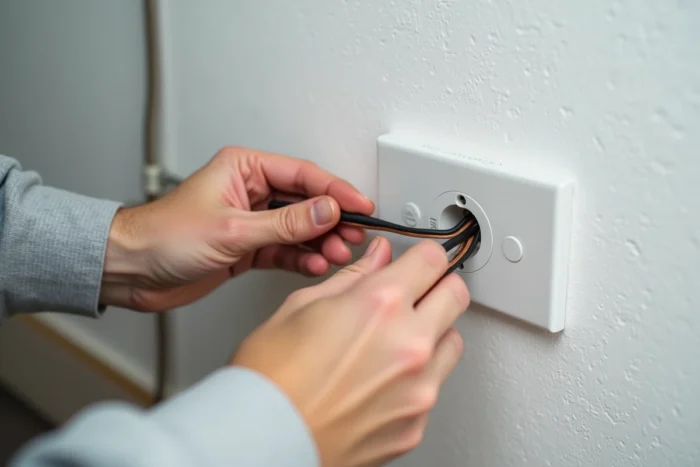
Turn off the main circuit breaker, gently remove the cover from a socket, and observe the wires connected behind. You should see three conductors: phase (red, brown, or black), neutral (blue), and ground (green-yellow). If only two wires are present, the socket is not connected to ground.
In homes built before the 1970s, it is common for sockets to have only two wires. The ground pin then serves as a mechanical decoy, without real connection.
Indicator lamp and lamp-test method: limits and precautions
You may find suggestions on forums to make a lamp-test with a bulb and two wires to check the continuity of the ground. This method involves connecting one wire to the phase and the other to the ground pin: if the lamp lights up, the ground would be connected.
This technique carries several serious risks:
- You handle a live conductor without protection, with a risk of direct electrocution.
- A lamp that lights up does not prove that the ground is of good quality, only that a conductive path exists.
- If the neutral and ground are confused (wiring fault), the lamp will still light up, but the protection is nonexistent.
The lamp-test is not recommended for individuals. The socket tester with indicators provides the same basic information without any dangerous handling.
When to call an electrician to measure the ground
The checks described above can identify the total absence of ground or faulty wiring. They do not replace a ground resistance measurement, which requires a dedicated device called a tellurometer.
The NF C 15-100 standard, whose major revision in 2024 strengthens the requirements for differential devices and specialized circuits, sets a strict framework for new and renovated homes. A professional electrician performs this measurement during a compliance diagnosis.
Call in a professional in these situations:
- The socket tester indicates an absence of ground on several sockets in the home.
- Your panel does not have a differential circuit breaker with appropriate sensitivity.
- You feel tingling when touching metal devices (washing machine, faucet, radiator).
- The home has never undergone an electrical diagnosis, especially if it dates from before 1990.
A socket tester costing a few euros and a visual inspection of the panel are sufficient to identify the most common situations. These two checks take less than ten minutes and require no electrical skills. If any doubt remains after these checks, measuring with a tellurometer by an electrician remains the only way to confirm that the ground is truly fulfilling its protective function.