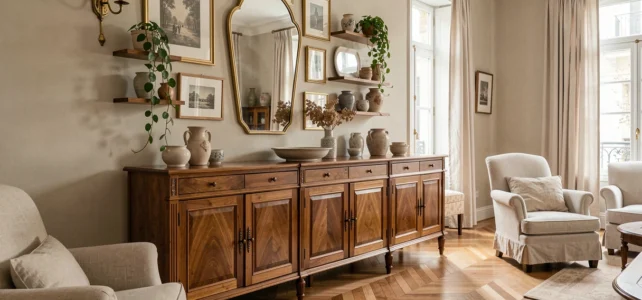
The wall above a sideboard represents a surface often underutilized in a living room. Its width, dictated by that of the furniture, offers a sufficient flat area to create a true focal point without touching the floor or rearranging the room. Here are ten concrete ideas to dress this space, from textured wall coverings to frame compositions, as well as lighting or plant solutions.
1. Textured plaster in tadelakt or lime for a signature wall
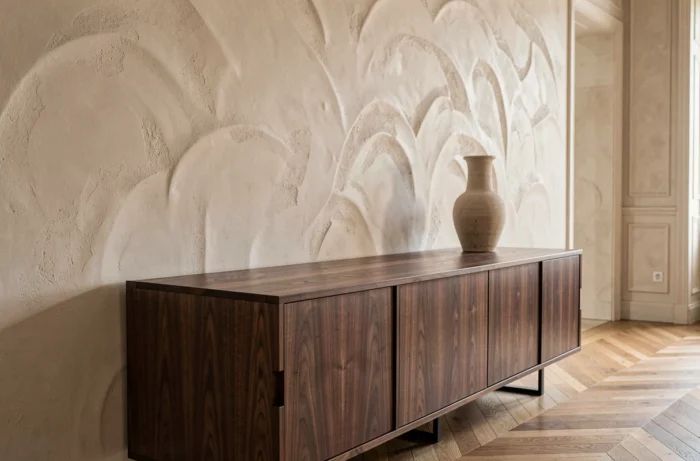
The trends for 2025-2026 make the most visible wall in the living room a fully-fledged architectural surface. Instead of hanging objects, the principle is to transform the very material of the wall with a mineral plaster: tadelakt, lime, polished concrete, or relief plaster.
Earthy tones (terracotta, ochre, clay) or deep greens work particularly well behind a light wood or black metal sideboard. The plaster creates a textural contrast that highlights the furniture without adding anything bulky. For more decor tips on CréAgencement, this textured approach is detailed with concrete examples.
The main limitation remains the implementation: tadelakt plaster requires specific expertise and a properly prepared surface. On a standard drywall, a bonding primer is necessary.
2. Large unique mirror with metal or raw wood frame
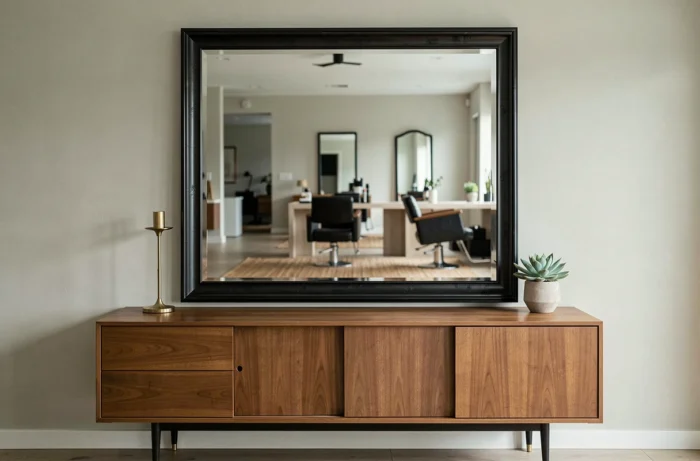
A large mirror placed above the sideboard visually enlarges the room by reflecting natural light. The frame defines the style: black metal for an industrial vibe, raw wood for a Scandinavian spirit, brushed brass for an Art Deco touch.
The rule to follow: the mirror must not exceed the width of the sideboard. An overflow creates an immediate visual imbalance. Center it and leave at least ten centimeters between the top of the furniture and the bottom of the frame to avoid a crushing effect.
3. Asymmetrical composition of photo frames and illustrations
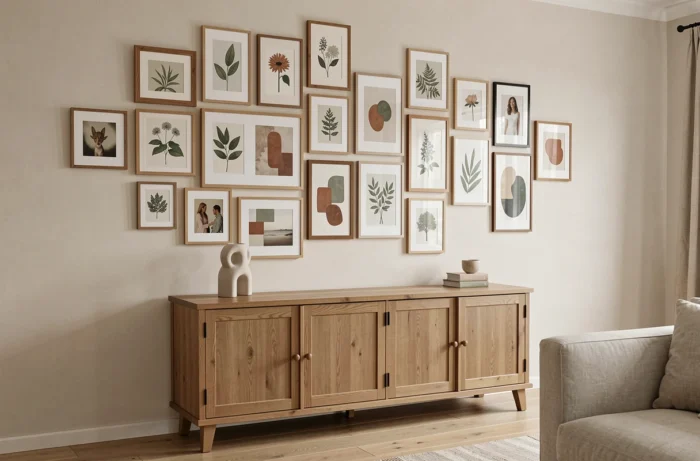
The wall gallery remains a classic, but its effectiveness depends on the hanging method. An asymmetrical composition, with frames of varying sizes and finishes, brings more character than a strict alignment.
To succeed in the ensemble, start by laying all the frames on the floor, respecting the available surface above the furniture. Keep a regular spacing of a few centimeters between each piece. Mixing black and white photographs, botanical illustrations, and small abstract formats creates depth without overcrowding.
4. XXL wall sconce as a decorative and lighting piece
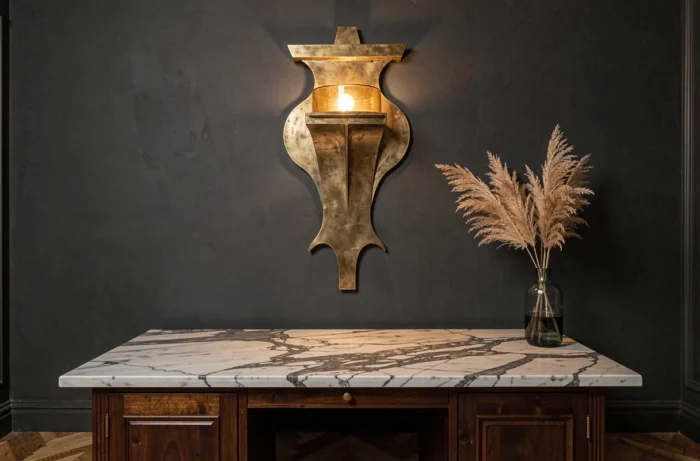
The wall sconce goes beyond its lighting function to become a fully-fledged decorative object. XXL models, halfway between a light fixture and a sculpture, dress the wall while projecting ambient light onto the sideboard and the objects placed on it.
Opt for a model with a dimmer switch. In the evening, the soft light transforms the sideboard area into a warm focal point. However, the wiring requires a wall outlet, which should be anticipated if it does not already exist.
5. Thin wall shelves for ceramics and small objects
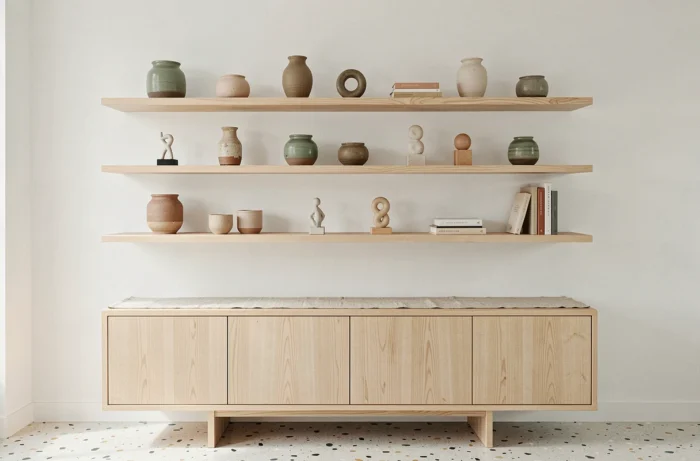
Thin shelves (a few centimeters deep) fixed above the sideboard extend the display surface without weighing down the wall. They are suitable for ceramics, vases, candles, or small frames that can be rearranged throughout the seasons.
A common pitfall is overloading. Two shelves are sufficient, with three to five objects per shelf. Vary the heights of the displayed pieces to break linearity. If the sideboard is dark wood, thin metal shelves provide a welcome material contrast.
6. Panel of vertical wooden slats
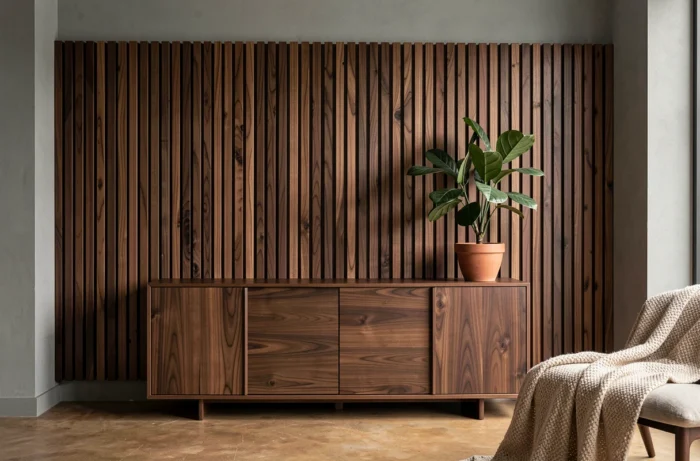
The slat panel creates a regular geometric relief that dresses an entire wall or just the part above the furniture. This treatment fits into the trend of natural materials and wood finishes that have dominated interiors for several years.
The slats are fixed to an MDF backing or directly to the wall, spaced regularly. Light wood (beech, natural pine) warms a living room with white walls, while dark-stained wood adds character to a larger space. Maintenance is limited to regular dusting.
7. Wall hanging in macramé or artisanal weaving
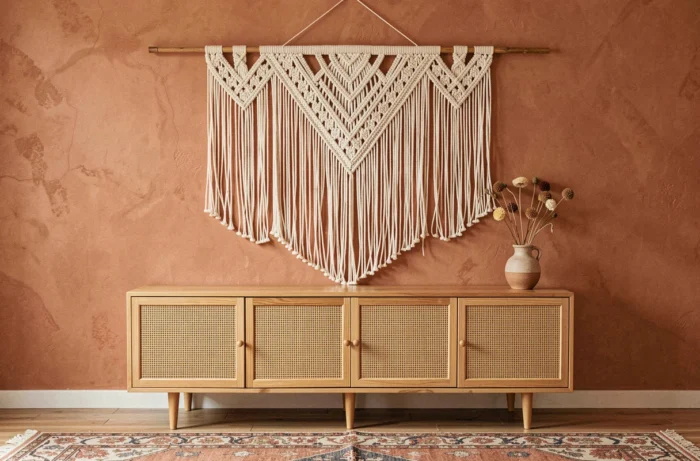
The wall hanging adds a textile dimension to the wall, breaking the rigidity of a smooth surface. Macramé, wool weaving, or suspended linen work well in bohemian or Scandinavian atmospheres.
Choose a piece whose width does not exceed two-thirds of that of the sideboard to avoid a curtain effect. Neutral colors (ecru, beige, light gray) fit into most palettes. A hanging that is too heavy may sag in the center: check that the rod or hanging support can bear the weight.
8. Oversized wall clock in metal or wood
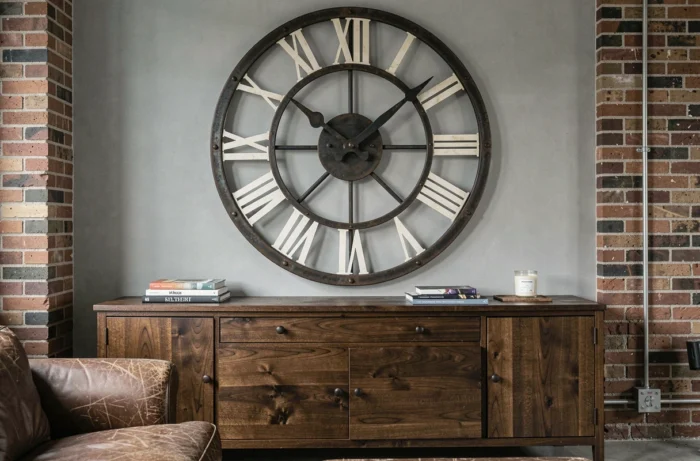
A large-diameter clock fills the wall by itself and adds a practical function. Models in perforated metal allow the wall color to show through in the background, lightening the visual presence of the object.
The style of the clock should match that of the sideboard. An industrial model with Roman numerals in metal pairs well with a wood and metal sideboard. A light wood dial without numbers fits better with a minimalist design.
9. Cascading plants in hanging pots
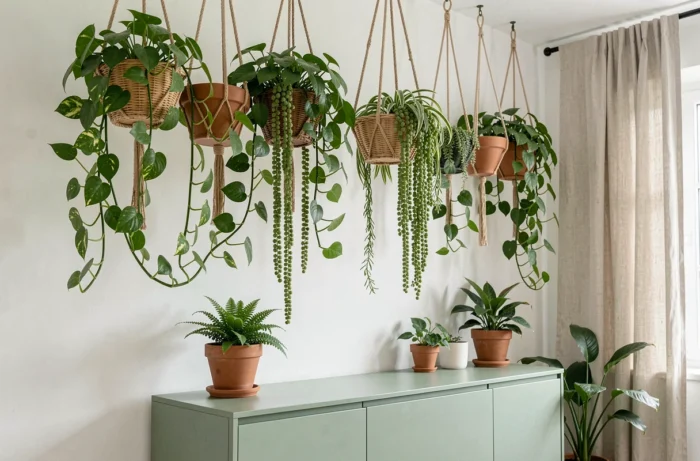
Suspending two or three pots above the sideboard introduces vegetation without cluttering the surface of the furniture. Cascading plants (pothos, ivy, heartleaf philodendron) create a natural green curtain that softens a too-bare wall.
- Attach the supports to the ceiling or a sturdy wall rod, checking the load capacity of the anchors
- Space the pots irregularly for an organic rather than symmetrical look
- Plan for waterproof cachepots to protect the sideboard from water runoff
10. Color drenching technique on the wall and the sideboard
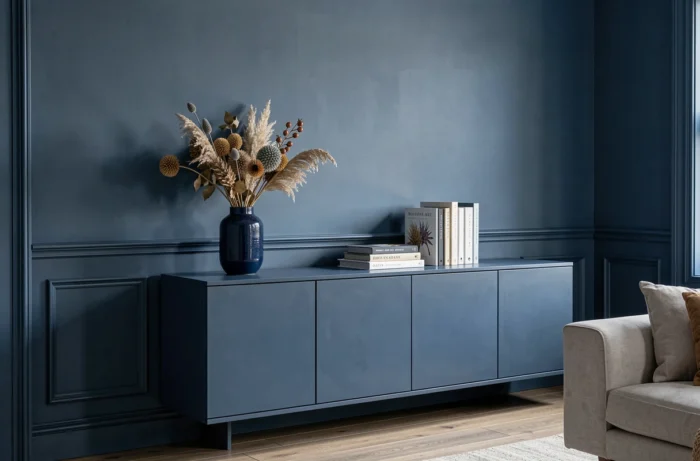
Color drenching involves painting the wall, woodwork, and sometimes the furniture in the same shade. Applied to the wall above the sideboard, it creates a visual unity that blends the furniture into the architecture of the room.
Sage greens, deep blues, or muted reds are the palettes that work best in this approach, according to the color trends for 2025-2026. The result is striking in a room with generous volumes but may darken a small space if the shade is too saturated. Always test a sample on the relevant wall before proceeding.
The choice between these ten approaches depends as much on the style of the sideboard as on the brightness of the living room and the available wall surface. A textured plaster or a slat panel transforms the space permanently, while a composition of frames or hanging plants can be modified according to desires.