Every new school year brings its share of colors, cuts, and materials to adopt. This season, fashion trends are not just about choosing between wide jeans or a fitted dress. They also play out on a less visible field: that of garment traceability, advertising regulations, and the rise of second-hand fashion.
Textile Traceability and Digital Passport: What’s Changing for Your Wardrobe
Have you noticed those QR codes on the labels of certain garments? They are not there by chance. The digital product passport, driven by European regulations, is beginning to structure the textile market. A European registry has been active since July 2026, and specific obligations for textiles will follow.
In practical terms, this passport gathers information about a garment’s composition, its place of manufacture, and its repair possibilities. For you, this means direct access to the true origin of each piece you purchase.
This mechanism encourages brands to rethink their collections. Those that focus on traceable materials and short supply chains gain credibility. To find pieces that meet this transparency requirement, browsing the Omniz fashion site already allows you to spot selections that incorporate these criteria.

Fall-Winter 2026 Trends: Key Pieces to Remember
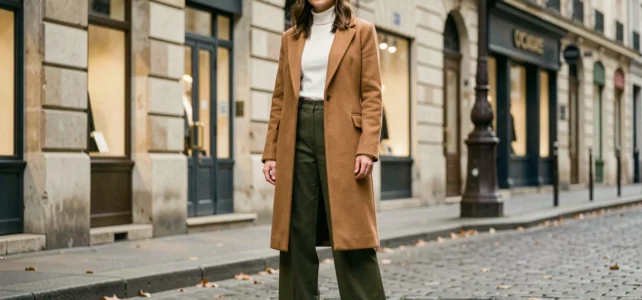
The fall-winter 2026 season is built around a few strong axes. The menswear-womenswear wardrobe continues to blur the lines: oversized blazers, wide pleated trousers, structured shirts. Bright colors remain present, but they are worn in touches, against a backdrop of muted tones.
Materials and Cuts Defining Style This Season
Heavy and textured materials dominate the collections: boiled wool, corduroy, soft leather. These fabrics add volume without overwhelming the silhouette. In terms of cuts, wide trousers remain the key piece, ranging from jeans to dressy fabrics.
The long dress, worn with flat boots, establishes itself as an alternative to the pants-sweater combo. It works well in both urban settings and more casual contexts.
- The oversized blazer, worn belted or open, replaces the lightweight jacket as the first chills set in.
- Burgundy, khaki, and petrol blue return as base shades for fall looks.
- Straight or slightly flared jeans take over from skinny styles, with raw or lightly faded washes.
Adopting these pieces does not require overhauling your entire wardrobe. Three or four well-chosen pieces are enough to anchor a look in the season, especially if they are combined with basics already present in your closet.
Second-Hand and Upcycling: Building a Unique Style Without Buying New
Second-hand is no longer a default choice. It is becoming a structuring axis of the market, driven by both regulations and evolving practices. In France, the ban on destroying unsold goods now applies to large companies, which directly feeds into reuse circuits.
Brands are launching entire collections made from recovered fabrics. Upcycling, which involves transforming an existing garment into a new piece, allows for the creation of looks that no one else will wear. This is the very definition of unique style.
Sourcing the Right Second-Hand Pieces for Fall
For the fall-winter 2026 season, certain vintage pieces are particularly well-sourced second-hand:
- Wool coats from the 1980s-1990s, often better cut and thicker than current entry-level models.
- Cable-knit sweaters, which return every winter and can be easily found in thrift stores.
- Leather accessories (belts, bags, boots) that age beautifully over time and gain character.
Choosing second-hand also means avoiding pieces from ultra fast fashion, which are now subject to advertising restrictions in France. Since September 2026, direct or indirect advertising for these products is regulated, and influencers promoting them face potential sanctions.
Anti Fast Fashion Law and Environmental Claims: Impact on Your Fashion Choices
France has taken a clear stance on ultra fast fashion. Products in this category are subject to restrictions: limitations on the use of the word “free,” regulation of commercial communication, potential additional costs. These measures directly target platforms that offer clothing at very low prices with a constant turnover of collections.
For consumers, the consequence is twofold. On one hand, the artificially low prices of certain platforms will gradually incorporate their real costs. On the other hand, brands that claim environmental commitments must now prove them, or risk falling under the rules on environmental claims.
This regulatory framework is changing the way fashion is consumed. Buying less, but better, is no longer just a slogan. It is an economic and legal constraint that reshapes the available offer.
Adapting Your Habits Without Sacrificing Style
Building a distinctive look this season involves a few simple reflexes. Check the material composition on the label. Favor pieces with documented manufacturing. Mix traceable new items with quality second-hand.
Unique style does not come from the number of pieces purchased, but from the coherence of choices. A well-cut vintage coat, a pair of raw jeans, and a knit sweater are enough to create a solid autumn silhouette. The rest is a matter of proportions and colors.
The rules of the game are changing for fashion. Traceability, the end of unregulated advertising for ultra fast fashion, and the rise of reuse are not abstract constraints. They redefine what is available on the shelves and what deserves a place in your wardrobe. This season, true style also involves being aware of what you wear and where it comes from.