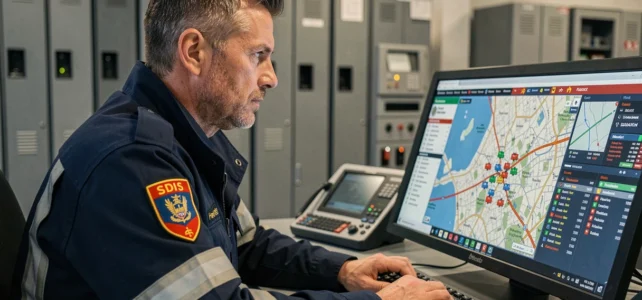
IRIS Pompier operates as an operational extranet deployed within several SDIS to centralize the daily management of interventions. Schedules, agent availability, mission tracking, dissemination of instructions: the tool gathers previously scattered data across multiple platforms into a single interface. Measuring the real impact of this centralization on the functioning of emergency centers requires comparing processes before and after deployment.
Management of SDIS interventions: before and after an operational extranet
The most tangible difference between an SDIS equipped with an extranet like IRIS Pompier and an SDIS operating with fragmented tools is evident in the handling of daily information flows. The team leaders, duty officers, and administrative agents handle the same data, but not at the same pace or with the same needs.
| Operational Function | Without centralized extranet | With IRIS Pompier |
|---|---|---|
| Agent availability | Declaration by phone or shared spreadsheet, deferred update | Direct entry by the agent, immediate visibility for the CTA/CODIS |
| Dissemination of instructions | Paper memos or emails, uncertain acknowledgment of receipt | Publication on the portal with consultation tracking |
| Post-intervention tracking | Manual reports sent by fax or internal mail | Online entry with timestamping and automatic archiving |
| Duty schedules | Excel spreadsheets managed center by center | Unified departmental schedule, editable in real-time |
| Access to operational documents | Physical binders in each fire station | Document database accessible from any connected workstation |
The main gain does not lie in the raw speed of call processing. It is found in the elimination of re-entries and manual checks that slow down the chain between receiving a call and the actual deployment of resources.
A telling example concerns the management of volunteer firefighters. Their availability fluctuates hourly. Without a centralized tool, the CTA must individually contact personnel to confirm their presence. With an extranet, each volunteer declares their availability autonomously, freeing up operator time when speed is most critical.
To better understand how this type of portal transforms the daily life of a departmental service, the use of IRIS Pompier by SDIS details the concrete case of the SDIS of Aisne and the reasons that have made the tool difficult to replace.
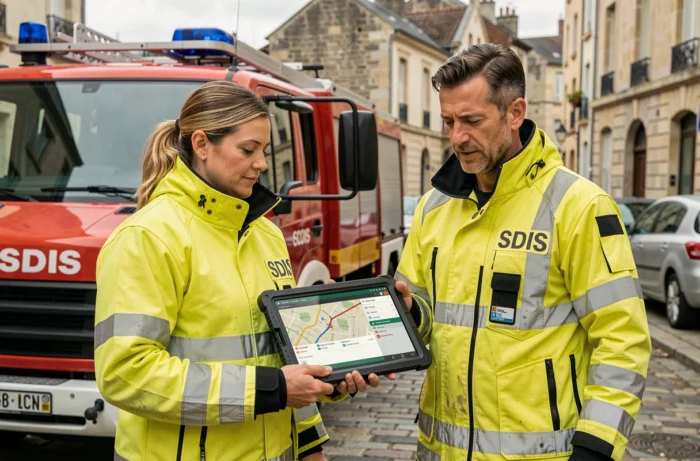
IRIS Pompier in the face of national platform logic: convergence or competition
The digital landscape of SDIS is not limited to departmental extranets. Two dynamics now coexist.
The first is local: each SDIS chooses its tools based on its budget constraints, IT infrastructure, and habits. IRIS Pompier fits into this logic, with deployment tailored center by center.
The second is national. The DGSCGC and CNES have launched the FireWatch platform, which combines satellite data and artificial intelligence for early fire detection. More than 50 SDIS are participating in the operational demonstration campaign 2026, following a prototype tested during the summer of 2025.
FireWatch does not replace an extranet like IRIS Pompier. The two tools do not operate at the same level:
- IRIS Pompier manages the organizational layer (schedules, availability, documents, daily mission tracking)
- FireWatch handles the decision-making layer upstream (detection of fire outbreaks, automated alerts, assistance in resource positioning)
- The national platform explicitly aims to integrate with the existing systems of SDIS, including operational software already in place
The challenge for an SDIS equipped with IRIS Pompier is therefore the capacity for interoperability between the local extranet and national platforms. A tool that correctly centralizes departmental data facilitates connection to a broader system. In contrast, an SDIS with data remaining siloed in spreadsheets or unconnected applications will have to make a much heavier integration effort.
Early detection by AI camera and alert escalation to SDIS
Several departments have deployed cameras coupled with artificial intelligence to detect smoke and fire outbreaks. In Dordogne, firefighters use cameras and AI to detect fire outbreaks. In Alpes-Maritimes, the Force 06 system monitors forested areas. In Côte-d’Or, an AI camera monitors fires over a radius of thirty kilometers.
These systems generate alerts that must reach operational centers. The value of an extranet is measured by its ability to absorb these alert flows without creating duplicates or informational dead zones. If the camera alert arrives through one channel and resource management goes through another, the risk of latency increases.
What multi-detection changes for team leaders
A team leader who consults IRIS Pompier before heading out on an intervention accesses up-to-date instructions, the availability of their team, and operational documents for the relevant sector. If tomorrow the platform integrates early detection alerts (AI camera or satellite), they will have tactical information and organizational information on the same screen.
This scenario remains conditioned by technical choices (open APIs, standardized data formats) and budgetary decisions specific to each departmental council. Not all SDIS are progressing at the same pace.
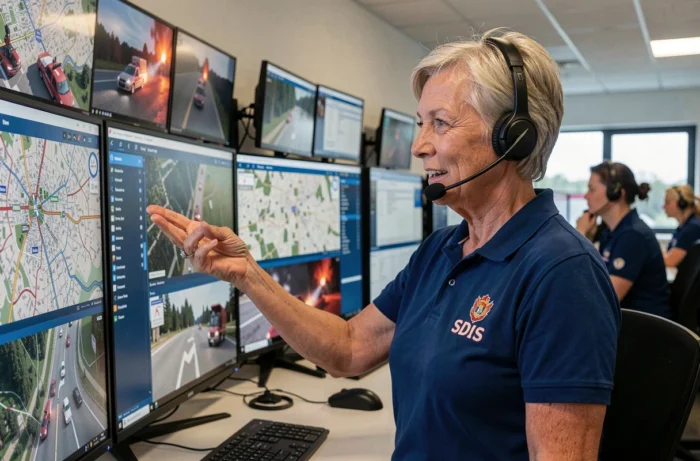
Operational data and traceability: what an SDIS extranet makes verifiable
Beyond real-time management, an extranet like IRIS Pompier produces a complete traceability of actions taken. Every schedule modification, every document consultation, every post-intervention report is timestamped.
For an SDIS managing hundreds of vehicles spread across dozens of centers, this traceability meets several simultaneous needs. The reconditioning of equipment after an intervention (respiratory devices, biomedical equipment, transmission equipment) requires precise knowledge of which equipment was used, by which center, and on what date.
The SDIS of Bouches-du-Rhône, with its 1,512 vehicles spread across 62 centers and its assistance to over 110,000 people per year, had identified this need for centralized visibility of stocks and repair requests. Traceability is not an administrative luxury: it conditions the ability to quickly replenish a center after a heavy intervention.
The operational extranet thus transforms the SDIS into an organization where every action leaves an exploitable trace, whether for feedback, internal audit, or budget planning. This layer of structured data is also what ultimately makes it possible to connect to national supervision platforms.