Expandable garden tables sold at Brico Dépôt change from season to season. The retailer renews its large capacity references every year, which makes general buying guides quickly obsolete as soon as they mention a specific model.
For a large family looking to seat eight to twelve people without breaking the bank, the choice relies less on a miracle reference than on a stable framework: mechanism, material, actual dimensions once unfolded, and the behavior of the tabletop after several seasons of intensive use.
Rotation of Brico Dépôt models: what it changes at the time of purchase
Brico Dépôt operates on seasonal arrivals. An aluminum expandable table spotted in April may disappear from the online catalog as early as June, replaced by a model with slightly different dimensions or colors. This rapid rotation system pushes large families to decide quickly, sometimes too quickly.
Before heading to the store, it is better to define non-negotiable criteria (unfolded length, minimum width, type of mechanism) rather than aiming for a specific reference. Comparing a Brico Dépôt expandable garden table with competing models based on these criteria allows for an objective assessment of whether the current arrival meets the actual need.
This logic of tight prices and large volumes also explains why finishes vary from one batch to another. The same “greige” or “anthracite” color may show slight differences in shade between two production seasons.
Powder-coated aluminum and intensive family use: the question of longevity
The majority of large format expandable tables offered in DIY superstores are made of powder-coated aluminum. This choice of material is not trivial for a large family that uses its table daily, not just on Sundays.
Aluminum does not rust, which solves the issue of exposure to the elements. However, the powder coating (the baked-on powder paint that covers the metal) undergoes gradual degradation due to UV exposure and repeated impacts. On a table used several times a week by six to ten people, micro-scratches quickly appear in the places where dishes and elbows are placed.
Thickness of aluminum profiles
Product sheets rarely mention the thickness of the profiles. A structure that is too thin vibrates when cutting meat or when a child leans on it. In-store, pressing firmly on the center of the unfolded tabletop allows for detecting excessive flexing. A tabletop that flexes when empty will pose problems under the weight of a full family meal.
Wood, woven resin, ceramic: alternatives and limitations
Wood (acacia, eucalyptus) offers a warm appearance but requires regular maintenance, which is incompatible with a use where the table remains outside all season without a cover. Woven resin is easy to clean, but extension mechanisms on resin structures are less common in large formats. Ceramic, more resistant to scratches and stains, raises the price well beyond Brico Dépôt’s usual pricing.
Extension mechanism: butterfly, removable extension, or end extension
The mechanism determines the ease of use on a daily basis. For a family that unfolds and folds its table several times a week, this criterion weighs as much as the material.
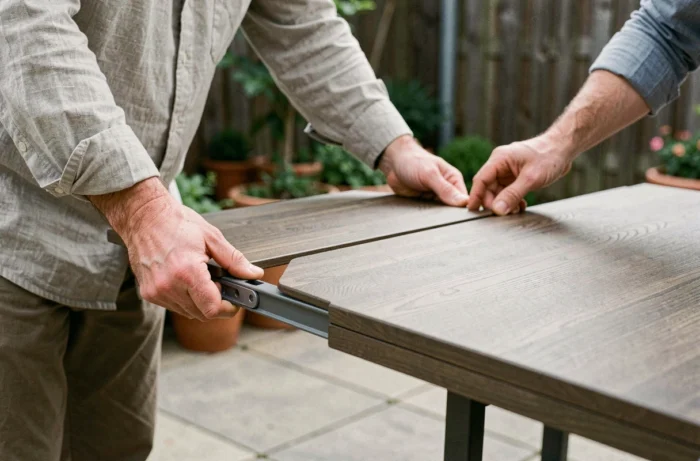
- The butterfly extension is integrated under the tabletop and unfolds by pivoting. It avoids the need to store a separate piece, but the guiding rail can jam if sand or crumbs accumulate in the groove.
- The removable central extension is stored separately. It often offers a more generous length gain but requires storage space and two people for handling in large formats.
- The end extension, clipped to one end, is the simplest mechanically. However, it creates an asymmetry: guests seated at the extended end may find themselves misaligned with the table leg, which reduces legroom on one side.
Field feedback varies on the durability of entry-level butterfly mechanisms. Some users report play at the junction after two or three seasons, while others observe no issues. The quality of the rail and hinges, rarely detailed on product sheets, makes all the difference.
Unfolded dimensions and tabletop width: the numbers to check for a large family
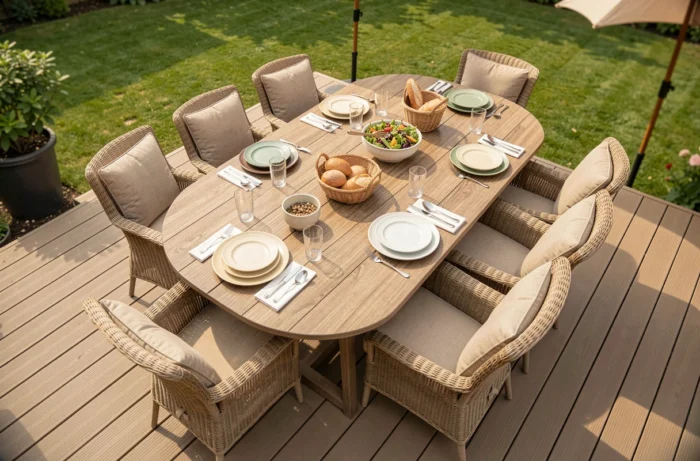
Length captures all the attention, but the width of the tabletop determines the actual comfort of the meal. A table longer than two meters but only 70 cm wide makes serving dishes cumbersome: arms cross, glasses tip over.
For a family meal where dishes are shared in the center, a width between 80 and 100 cm is significantly more functional. Beyond 100 cm, conversation between guests facing each other becomes difficult outdoors, where ambient noise drowns out voices.
Floor space once the table is deployed
Unfolding an expandable table is pointless if one can no longer move around it. Allowing at least 70 cm of clearance behind each occupied chair enables passage without needing to ask everyone to stand up. On a standard terrace, this means that the deployed table plus occupied seating easily occupies three meters in depth.
Measuring the available space on the terrace or in the garden before purchase seems obvious, but returns to the store due to the table being too large once opened remain frequent. A tape measure and five minutes are enough to avoid this problem.
Value for money in DIY superstores: what you really pay for
Brico Dépôt positions its large format expandable tables at prices significantly lower than those of specialized garden furniture retailers. This positioning is explained by large purchase volumes and less refined finishes: visible welds, limited colors, basic hardware.
For a family primarily looking for a solid and functional table, these aesthetic compromises are acceptable. However, checking the supplied hardware and the quality of the foot caps at the time of pickup in-store helps avoid discovering a missing part or damaged threading during assembly.
The market for large format garden furniture at tight prices is becoming denser each year. DIY retailers are strengthening their expandable ranges to meet a demand driven by large families that often host. Choosing a table based on the mechanism, actual width, and thickness of the structure rather than solely on the displayed price remains the most reliable method to avoid regretting the purchase two summers later.