
A French postal address is composed of distinct fields, each serving a specific function in the delivery of mail. Locality, street, and address complement do not refer to the same geographical reality, and confusing them can lead to distribution errors, delivery delays, or failures in fiber optic connections.
Why the street name should not contain parentheses or special characters
The Local Address Base (BAL), a reference framework managed by the ANCT, imposes a strict rule: the street name must not contain any mention in parentheses or special characters. A label like “Rue de la Gare (côté lotissement)” is non-compliant.
The reason is technical. Postal sorting machines and GPS systems analyze the street label as a standalone block. A parenthesis inserted in this block disrupts automatic reading and can return an unknown address.
Mentions of subdivisions, buildings, or commercial names must be reported in a separate field: the address complement. This principle of separation allows for distinguishing between these address elements unambiguously for postal and digital operators.
Locality in a postal address: definition and role in the postal code
The locality refers to the destination municipality of the mail. It appears on the last line of the address, associated with the postal code. This postal code/locality pair constitutes the first level of sorting: it directs the mail to the competent distribution office.
In France, the locality generally corresponds to the official name of the municipality as it appears in the Official Geographic Code (COG) published by INSEE. Accents, hyphens, and articles are integral parts of the name. Writing “SAINT GREGOIRE” instead of “SAINT-GRÉGOIRE” can create inconsistencies in databases, even though mail often arrives at its destination thanks to the tolerance of sorting systems.

A common pitfall concerns delegated municipalities resulting from recent mergers. The name of the former municipality may still appear on envelopes while the official locality has changed. The best practice is to use the name of the new municipality on the locality line and to report the old name in the complement if necessary.
Street name and number: what identifies the delivery point
The street is the thoroughfare on which the residence or premises is located. Its label includes two elements:
- The type of street (street, avenue, path, dead end, square, road, alley), which describes the nature of the thoroughfare. It is placed before the proper name of the street.
- The name of the street itself, assigned by a resolution of the municipal council in accordance with Article L. 2121-29 of the General Code of Local Authorities.
The number in the street precedes the type. It identifies the exact delivery point. A complete address therefore reads: 12 Rue Victor Hugo, and not Rue Victor Hugo 12 (format used in other countries).
Numbering is mandatory for all municipalities since the 3DS law, including those with fewer than two thousand inhabitants. This obligation, effective since June 2024, has accelerated the formalization of addressing in rural areas. Before this law, many households in France did not have precise addresses, complicating the intervention of emergency services and the deployment of fiber optics.
Place name and street: do not confuse the two lines
In hamlets or place names served by multiple streets, the place name should be placed in the address complement and not as the street name. This practice avoids artificial designations and maintains continuous numbering along each thoroughfare.
Concrete example: a hamlet “Les Music” crossed by two distinct paths. Each path receives a proper name (Chemin des Music Nord, Chemin des Music Sud) and the place name “Les Musics” goes in the complementary line. The recipient can then be located by their number in the street, not just by the name of the hamlet.
Address complement: the line often filled out incorrectly
The address complement groups all the information that does not fall under the street or locality but is necessary to reach the recipient within a built environment. It includes:
- The building, staircase, or apartment number
- The name of the residence or subdivision
- The mention “Mailbox” followed by its number, in buildings with grouped mailboxes
- The place name when it does not constitute the street name
This line appears above the street line on the envelope. It refines the location without replacing the street number. Writing “Résidence Les Lilas” without a street number forces the mail carrier to search among several possible entries.
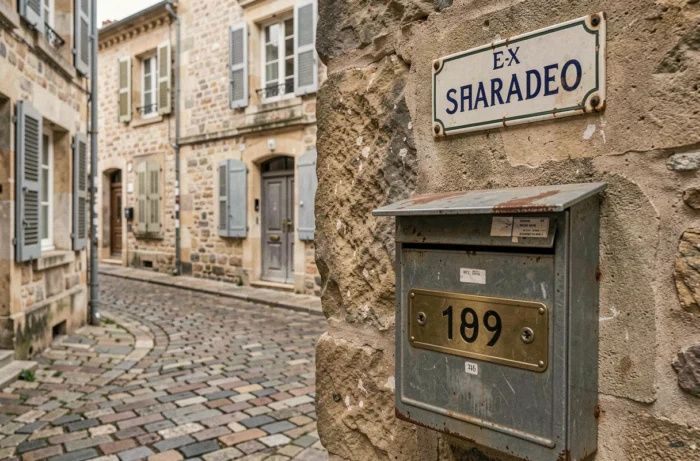
The most common mistake is to move the complement up to the street line, creating a hybrid label like “3 Rue de la Paix Bât B Appt 42”. This format does not comply with postal recommendations and regularly causes rejections in online forms that validate the address via the BAL.
Standardized address: how to check the compliance of each line
To determine if an address is correctly structured, a simple test works: each line must answer a single question.
- Complement line: where exactly in the building? (Bât C, Appt 7)
- Street line: what number, on which street? (14 Avenue de la République)
- Locality line: in which municipality, what postal code? (35000 Rennes)
If a single line contains the answer to two of these questions, the address is poorly structured. This principle applies equally to paper mail and to the input fields of digital forms, where confusion between street and complement generates addresses that cannot be found in national references.
Municipalities wishing to update their addressing publish their Local Address Base on adresse.data.gouv.fr, where each address is structured according to these three levels. A clean addressing facilitates mail distribution, digital connection, and emergency intervention – three services that all depend on the same well-defined data.