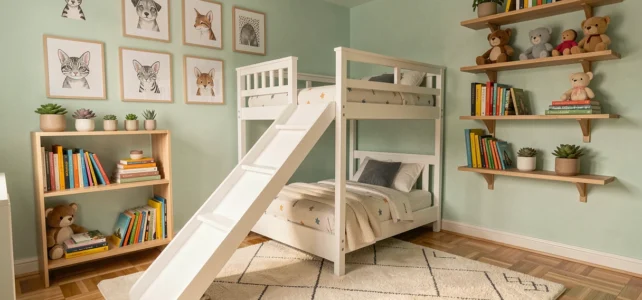
A child’s room simultaneously fulfills three distinct functions: sleeping, playing, learning. Every piece of furniture and every color choice affects how the child uses their space on a daily basis. Designing a room that is both stylish and playful requires balancing normative safety criteria, furniture durability, and decorative coherence, without sacrificing one for the other.
Child furniture safety standards: what decor guides overlook
Before choosing a bed or storage, regulatory compliance is the first filter. The European standard EN 716 governs cribs (spacing of elements, mechanical resistance), while the standard EN 747 regulates bunk beds and loft beds.
The DGCCRF reminds us that elevated sleeping arrangements are not suitable for children under six years old. The warning must appear on the furniture itself, on the packaging, and in the instructions. A loft bed purchased solely for its aesthetic, without checking these mentions, poses a real risk of falling.
Among the specialized brands, moonkidsstore.be offers children’s furniture designed to meet these requirements while ensuring a stylish design. Checking for the presence of regulatory markings on each piece remains the most reliable reflex at the time of purchase.
Transformable furniture: investing in longevity rather than trends
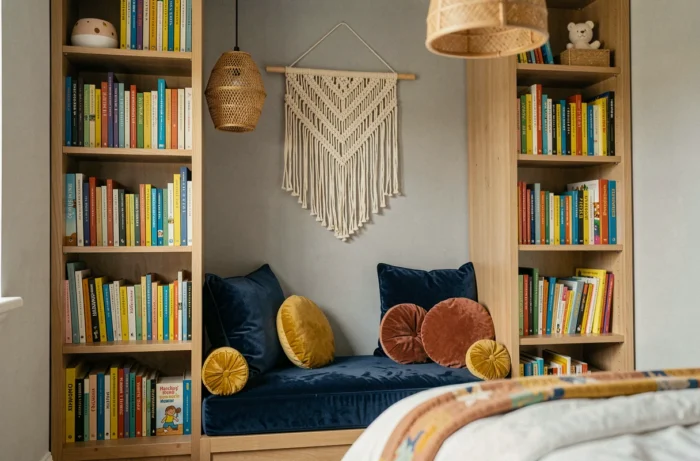
The concept of furniture that grows with the child goes beyond simple marketing arguments. A transformable bed with an extendable frame, an adjustable-height desk, repositionable shelves: these pieces accommodate several years of growth without complete replacement.
The benefits are twofold. On one hand, the overall budget decreases as replacements are spaced out. On the other, the room maintains aesthetic coherence over time, as the basic furniture remains the same while only the accessories (cushions, posters, bedding) change with the child’s tastes.
Criteria for choosing durable furniture
- Favor solid wood or birch plywood structures, whose mechanical resistance supports successive adjustments without play in the joints.
- Ensure that the extension system (bed extension, desk riser) uses the same hardware as the original structure, to avoid unfindable parts after a few years.
- Choose neutral finishes (natural wood, white, light gray) for the main furniture: it is the textiles and wall decor that will bring personality, not the furniture itself.
Color palette for a child’s room: beyond all-beige
Decor trends for 2026 are moving away from all neutrals. The palettes are enriched with more expressive shades: sage green, terracotta, deep blue, burgundy accents. Beige minimalism is giving way to combinations where a strong color interacts with a light background.
Applying intense color to just one wall or an architectural element (niche, door frame, painted headboard) is enough to anchor the atmosphere without overwhelming the room. The rest of the walls retain a neutral tone that reflects light and gives an impression of space.
Combining patterns and colors without overcrowding
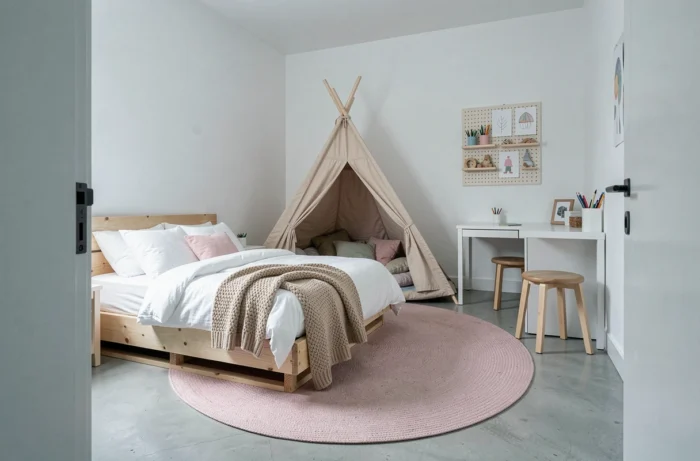
The most effective rule is to limit the room to a maximum of three colors (one background, one accent, one reminder in the textiles). Patterns (animals, geometric shapes, plants) work better in small touches, on a cushion or a curtain, than on four entire walls. One strong pattern per room prevents visual saturation and allows for easily renewing the atmosphere by changing a textile rather than repainting.
Accessible storage and activity zones: structuring the floor space
A common mistake is to think of a child’s room from an adult’s perspective: high storage, out-of-reach shelves, a desk pushed against a wall without natural light. A truly functional room is structured at child height.
Open bins placed on the floor or on a low shelf allow the child to tidy up independently. A modular cubby furniture is a great replacement for a traditional dresser, as it allows for immediate visual sorting (one bin per category of toy).
Defining without partitioning
In a single room, separating areas (sleep, play, work) relies on visual markers rather than imposing furniture. A rug defines the reading corner. A change in wall color signals the desk area. Each identifiable zone helps the child transition from one activity to another without the room feeling cluttered.
- The sleeping area gains comfort with soft lighting (adjustable wall lamp, warm light garland) distinct from the main ceiling light.
- The play area occupies the most open space, ideally near the source of natural light, with an easy-to-clean floor (washable rug or vinyl).
- The work area requires a stable surface, seating at the right height, and direct lighting, even for a child who is not yet doing homework: drawing and crafting require the same conditions.
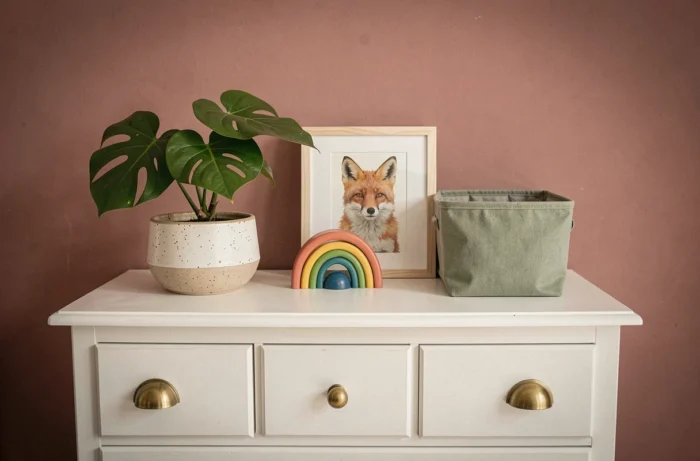
The choice of furniture and decor for a child’s room relies less on current trends than on three concrete considerations: compliance with safety standards, the furniture’s ability to last for several years, and the structuring of space at the child’s scale. A room where each zone has its function and where the palette remains controlled ages better than a space overloaded with trendy accessories.