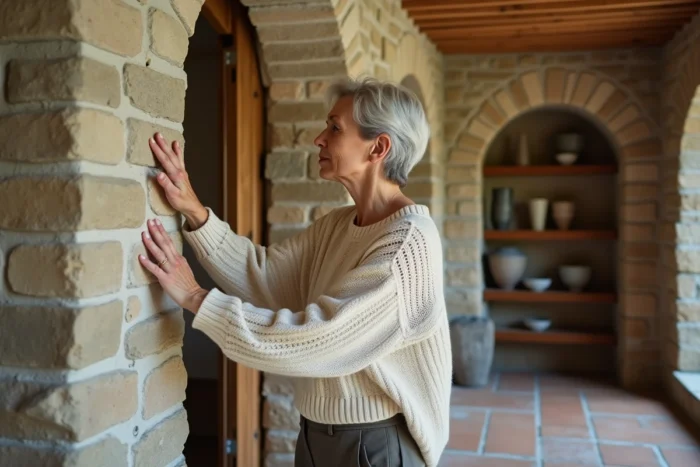
A granite wall of sixty centimeters is reassuring on paper. In reality, when the thermometer drops in January, one quickly feels that the stone stores cold as much as heat. Keeping warmth in an old stone house requires addressing every weak point of the structure without compromising what has kept these walls standing for centuries: their ability to breathe.
Regulatory exemption for stone facades: what it changes before touching the walls
Before planning insulation, one must check a point that most guides overlook. The Building Code mandates insulation work during facade renovations or roofing work affecting at least half of the surfaces. However, it provides an explicit exemption for materials sensitive to moisture, including stone facades and lime-based plasters.
In practice, an owner of an old stone house may be exempt from external thermal insulation when it risks degrading the structure. This is not a mere administrative detail: it is the foundation of any renovation strategy. If a synthetic insulator is applied to a stone wall that needs to expel its moisture, it creates a condensation trap.
One can also keep the coolness in a stone house according to Bobo Le Brico by taking advantage of this same thermal inertia in summer, which confirms that the stone wall works both ways, provided that its hygrometric exchanges are not blocked.
Interior insulation in old stone: choosing an insulator that allows the wall to breathe
Interior insulation often remains the only realistic option when the facade has heritage value or when the exemption applies. The choice of material is then crucial.
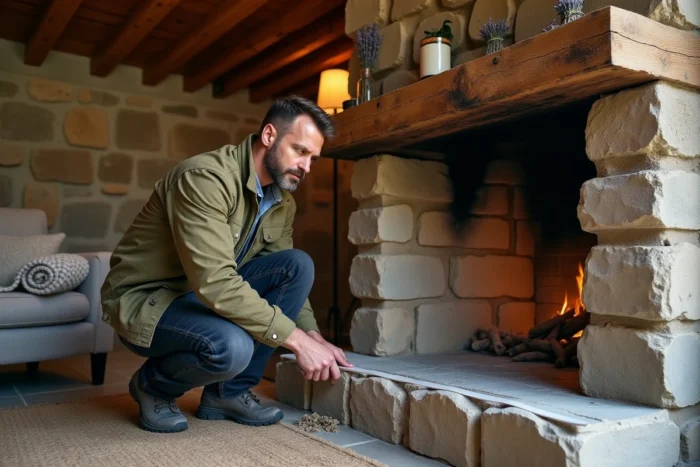
Closed-cell insulators (polystyrene, polyurethane) block the migration of water vapor. On a stone wall that naturally absorbs moisture from the ground through capillarity, a waterproof insulator causes condensation between the wall and the lining. Mold can then appear within a few seasons, sometimes leading to structural damage to the lime mortar.
Breathable materials yield better results on this type of structure:
- Wood fiber, in rigid or semi-rigid panels, regulates humidity while providing good thermal lag, which is also useful in summer to slow down incoming heat
- Expanded cork, rot-proof, works well in ground-floor rooms where capillary rise is frequent
- Lime-hemp plaster, applied directly to the wall, provides both insulation and hygrometric correction without creating a trapping air gap
Feedback varies on the necessary thickness depending on the type of stone (soft limestone, granite, schist), but generally, a compromise is sought between thermal performance and preservation of living space.
Windows and roofing: the two areas that truly change indoor temperature
One can treat the walls carefully; if the roofing is not insulated and the windows let air through, the effect will be marginal. In an old house, the roof represents the primary source of thermal loss.
For attics, blown cellulose or wood fiber panels between rafters provide immediate comfort gains in winter. These materials are compatible with old structures that tolerate humidity variations.
Windows: sealing without stifling ventilation
Replacing old joinery with high-performance double glazing significantly reduces drafts. However, one often encounters a common trap: very airtight joinery without an appropriate ventilation system generates mold. The absence of a mechanical ventilation system (VMC) or air inlets in a suddenly airtight home necessitates maintaining a constant airflow.
The solution lies in installing a humidity-controlled VMC, which adjusts the extraction flow to the ambient humidity level. This way, unnecessary ventilation is avoided when the air is dry (and heat loss is minimized), while excess humidity is expelled when it arises.
Thermal curtains, seals, and daily actions to retain heat in winter
Heavy solutions (wall insulation, window replacement, roof repair) are not always immediately feasible, whether for budgetary reasons or due to co-ownership. Several concrete actions can improve the thermal comfort of a stone house without major renovations.
Thick thermal curtains in front of windows and entry doors create an additional barrier against the radiant cold from the glazing. A sufficiently dense fabric that reaches the floor is preferred to limit the convection of cold air along the wall.
- Install silicone or foam sealing strips on openings that no longer close properly, ensuring that at least one low air inlet remains functional per room
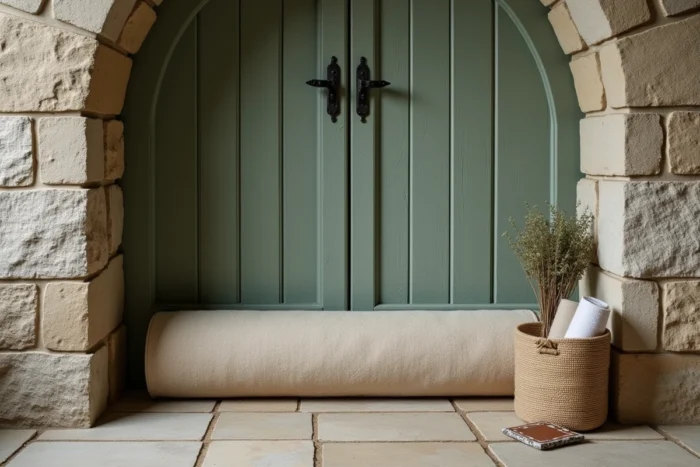
- Use door draft stoppers at the bottom of doors leading to unheated rooms (cellar, pantry, adjoining garage)
- Close shutters as soon as night falls: the air trapped between the shutter and the glazing acts as a natural insulator, reducing nighttime cold radiation
- Lay thick rugs on stone or terracotta floors, especially on the ground floor where contact with the cold ground amplifies discomfort
Taking advantage of passive solar gains
On winter days, opening the shutters and curtains of south-facing windows allows solar heat to be captured. The mass of stone stores this energy and gradually releases it in the evening. This is the only time when the thermal inertia of the stone truly works in favor of indoor comfort in the cold season.
Closing shutters and curtains as soon as the sun sets preserves this gain. This simple daily cycle makes a measurable difference in the perceived temperature in south and southwest-facing rooms.
Retaining heat in an old stone house relies on a balance between insulation, ventilation, and respect for the hygrometric functioning of the walls. Any intervention that blocks the structure’s breathing ultimately costs more than the problem it intended to solve. Prioritize treating the roof and windows, choose breathable insulators for the walls, and complement with simple daily actions: this is the combination that lasts over time.