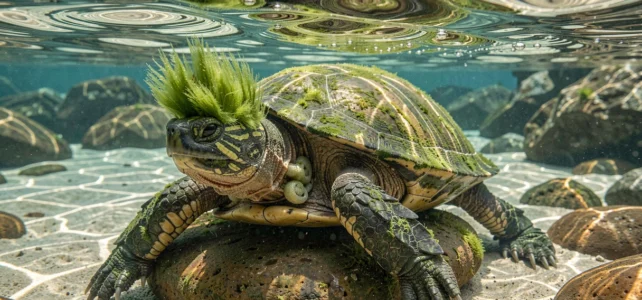
The Mary River turtle (Elusor macrurus) spends most of its day glued to the bottom of a fast-flowing Australian river, without coming to the surface for hours. What allows it to stay underwater for so long is not an extraordinary lung capacity, but an unexpected organ: its cloaca, the cavity common to digestive, urinary, and reproductive functions, which acts as a true respiratory exchanger.
Cloacal respiration of the Mary River turtle: an oxygen exchanger, not a gimmick
Inside the cloaca, structures called cloacal bursae are lined with blood vessels. Water from the river enters this cavity, and dissolved oxygen passes directly into the blood through the vascularized walls.
This system does not only activate in winter or during hibernation. In the Mary River turtle, cloacal respiration contributes to daily diving behavior. To understand in detail how the Mary River turtle breathes through its anus, one must look at the physics of gas exchange: the bursae function like a semi-permeable membrane constantly bathed by a flow of fresh, oxygenated water.
The Mary River, in Queensland, provides an ideal environment for this type of respiration. The current is strong, the water well-mixed, and rich in dissolved oxygen. The turtle exploits this environment without expending the energy needed to surface for air, a considerable advantage in a watercourse where predators watch for movements on the surface.
Energy optimization: why cloacal respiration changes everything underwater
Classic pulmonary respiration incurs a cost. Surfacing exposes the turtle to predators, requires muscular effort, and interrupts foraging on the bottom. Cloacal respiration eliminates these constraints.
Recent syntheses describe this mechanism not just as a zoological anecdote, but as a full-fledged energy optimization strategy. The highly vascularized cloacal bursae ensure sufficient gas exchange to cover a significant portion of the animal’s oxygen needs while at rest or moving slowly.
Thus, the Mary River turtle can:
- Remain submerged for much longer than similarly sized species lacking this mechanism
- Feed on algae and small invertebrates on the bottom without interruption, where other turtles must alternate between diving and surfacing
- Reduce its exposure to raptors and monitor lizards that patrol the surface or banks
This is not a backup system activated in times of stress. It is a complementary respiratory mode used continuously, redefining how this turtle occupies its habitat.
Algae on the head and multifunctional cloaca: the unique anatomy of Elusor macrurus
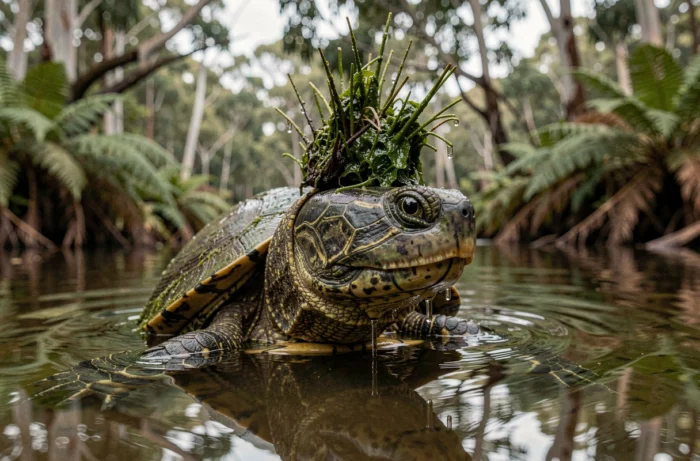
The Mary River turtle is recognizable by the crest of green algae that grows on its skull, sometimes on its shell. These algae develop because the animal remains motionless for long periods at the bottom of the river, precisely thanks to its cloacal respiration capability.
The cloaca serves three functions in this species: excretion, reproduction, and respiration. This anatomical versatility is rare at such a level of efficiency. Other freshwater turtles possess cloacal bursae, but in Elusor macrurus, the vascularization is particularly developed, making gas exchange more efficient.
A species discovered late by science
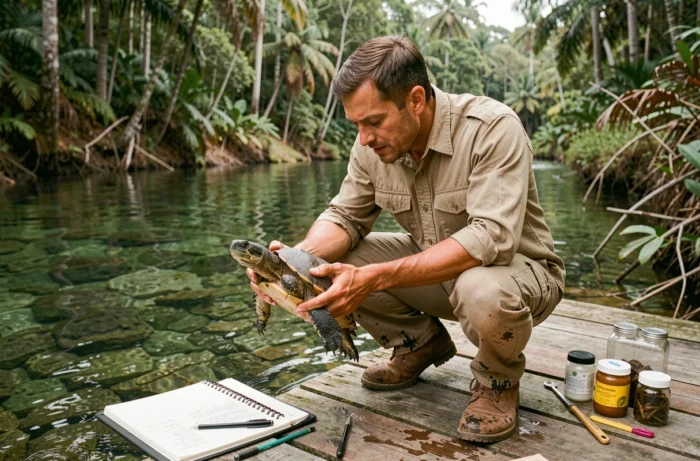
The Mary River turtle was only formally described in 1994, even though it had been sold as a pet in Australia since the 1960s. Decades of nest harvesting weakened populations even before the species was identified as distinct.
It is now classified as “Endangered” on the IUCN Red List. Recent work now incorporates genetic data and “Green Status” assessments to measure not only the risk of extinction but also the potential for species recovery. Reports vary on the actual rate of population recovery, but protection programs for nesting sites along the Mary River remain the main lever.
Mary River turtle and conservation: what genetics changes in the IUCN assessment
The “Endangered” classification dates back to 2018. Since then, assessment methods have evolved. The IUCN now uses complementary tools, including the Green Status, which does not merely measure proximity to extinction.
This approach evaluates a species’ recovery potential based on:
- The remaining genetic diversity in wild populations, an indicator of long-term adaptability
- The effectiveness of existing conservation measures (bank protection, management of invasive species like the red fox)
- The connectivity between subpopulations along the Mary River basin
Elusor macrurus is endemic to a single watershed, making each subpopulation genetically valuable. The loss of a nesting site not only affects the number of individuals but also reduces the genetic variability available for the entire species.
The Mary River turtle concentrates two features that make it a remarkable case study: a respiratory mechanism that transforms its cloaca into a functional gas exchange organ, and a conservation status that illustrates the limits of binary classifications of “threatened or not.” The species is endemic to a single Australian watershed, where the protection of the last nesting beaches remains the determining factor for maintaining populations.